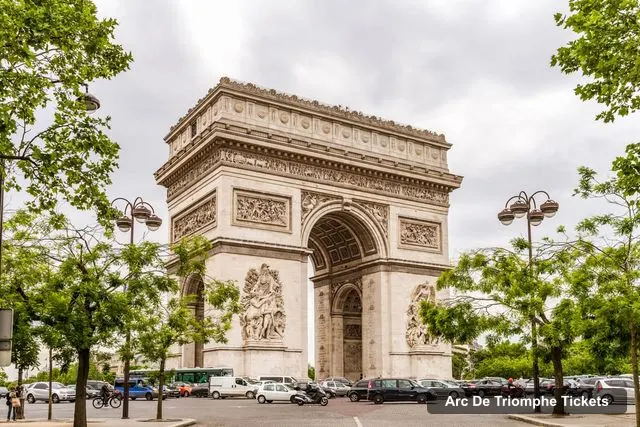
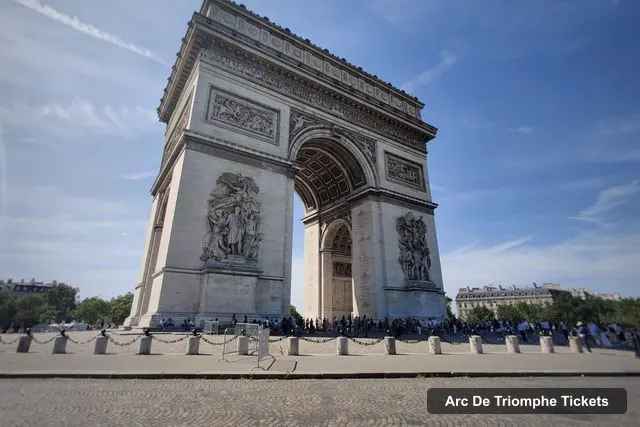
Arc de Triomphe facts are easiest to hold on to when each one has a date and a source, so this page gives you a timeline, the story period by period, and a numbered list of sourced facts. I took the history from Wikipedia and the figures from Wikipedia and Wikidata, and I give numbers exactly as those sources give them. If you would rather skip the reading and go up, my page on Arc de Triomphe tickets compares every option I found.
Arc de Triomphe History Timeline
Year
What happened
1806
Construction starts on 15 August, ordered by Napoleon I after Austerlitz
1810
A wooden mock-up stands for Napoleon’s entry into Paris with Marie-Louise
1811
Architect Jean-Francois Chalgrin dies; Louis-Robert Goust takes over
1823
Work resumes after a halt under the Bourbon Restoration
1836
Inaugurated on 28 July under Louis Philippe I
1885
Victor Hugo’s funeral procession passes the arch on 31 May
1919
Charles Godefroy flies a biplane under the main vault on 7 August
1920
The Unknown Soldier’s coffin is placed in the first-floor chapel on 10 November
1921
The coffin is placed in its final resting place on 28 January
1944
Parades mark the liberation of Paris
1995
A bomb placed near the arch wounds 17 people
2007
A permanent interior exhibition opens in February
2021
The arch is wrapped in fabric for L’Arc de Triomphe, Wrapped
2024
The arch features in the Paris Summer Olympics
Arc de Triomphe History: Who Ordered It and Why
The Arc de Triomphe was commissioned to honour those who fought and died for France during the French Revolutionary and Napoleonic Wars, according to Wikipedia. Napoleon I ordered it after the victory at Austerlitz, and construction started on 15 August 1806. It stands at the centre of the Place Charles de Gaulle, formerly the Place de l’Etoile, where 12 avenues radiate from the monument, and it sits where three arrondissements meet: the 16th, the 17th and the 8th.
The building took 30 years, and four architects worked on it. Wikipedia lists Chalgrin from 1806 to 1811, Goust, Jean-Nicolas Huyot and finally Guillaume-Abel Blouet, who saw it finished in 1836. Chalgrin died in 1811, and the Bourbon Restoration later halted the project until 1823. The final cost was about 10 million francs, per the same source.
Arc de Triomphe Facts on Size and Design
The Arc de Triomphe is not the tallest triumphal arch in the world, but it is the one most people picture. Wikipedia gives an overall height of 49.54 m, a width of 44.82 m and a depth of 22.21 m; Wikidata rounds the height to 49.5 m. The large vault is 29.19 m high and 14.62 m wide, and the smaller transverse vaults are 18.68 m high and 8.44 m wide.
For comparison, Wikipedia lists Mexico City’s Monument to the Revolution at 67 m, Pyongyang’s Arch of Triumph at 60 m and the Grande Arche at La Defense at 110 m. That last one, built in 1982, sits on the same axis as the Arc de Triomphe, which is a good thing to know when you look down the avenue from the roof.
Arc de Triomphe Facts in Stone: Sculpture and Names
Four main sculptural groups decorate the arch, and Wikipedia names them: The Departure of the Volunteers of 1792, known as La Marseillaise, by Francois Rude; The Triumph of 1810 by Jean-Pierre Cortot; and The Resistance of 1814 and The Peace of 1815, both by Antoine Etex. Six reliefs complete the facades. One of the odder Arc de Triomphe facts from that source: the sword of the Republic figure in La Marseillaise broke off in 1916, on the day the Battle of Verdun began.
The names are the part of the Arc de Triomphe facts that visitors read least and should read most. Wikipedia counts 158 battles engraved in total, 30 of them on the attic and 96 on the inner facades under the great arches, plus 660 officers and military leaders, including 558 French generals.
Arc de Triomphe Facts: The Unknown Soldier and the 20th Century
The arch changed from a monument to Napoleon’s armies into the country’s place of remembrance after the First World War. Wikipedia records that the Unknown Soldier’s coffin was placed in the first-floor chapel on 10 November 1920, the day before the Armistice Day ceremony, and moved to its final resting place on 28 January 1921. Beneath the vault lies the tomb, marked by an eternal flame for unidentified fallen soldiers of the French nation, as the Wikipedia summary in my data puts it.
Wikipedia also records a custom that outlasted regimes: when German forces marched through Paris in 1940, Hitler observed the custom of not marching through the arch, and in 1944 Charles de Gaulle observed the same custom at the liberation parade. In 1961 John F. and Jacqueline Kennedy visited the tomb with de Gaulle, and after the assassination in 1963 Jacqueline Kennedy asked for an eternal flame at Arlington, according to the same source.
Arc de Triomphe Facts From Modern Times
The arch has stayed a stage for national moments. It was cleaned by bleaching in 1965 and 1966, damaged by a bomb placed nearby in 1995 and used as a screen on 12 July 1998, when images of France’s World Cup winners were projected onto it after the 3-0 win over Brazil. A permanent interior exhibition opened in February 2007, and in late 2018 protesters vandalised the monument and its museum, per Wikipedia. In September 2021 the arch was wrapped in fabric, and in 2024 it featured during the Paris Summer Olympics.
For visitors the Arc de Triomphe facts end with the rooftop. Opening hours and closed days change, so check my guide to the Arc de Triomphe opening hours and the official site at paris-arc-de-triomphe.fr for your date. The Arc de Triomphe map page shows what you see inside and from the roof.
13 Arc de Triomphe Facts With Sources
Construction started on 15 August 1806 and the arch was inaugurated on 28 July 1836 (Wikipedia).
Wikidata gives 1836 as the opening year and Jean-Francois Chalgrin as the architect (Wikidata).
The overall height is 49.54 m according to Wikipedia and 49.5 m according to Wikidata (Wikipedia).
The arch is 44.82 m wide and 22.21 m deep (Wikipedia).
The large vault is 29.19 m high and 14.62 m wide (Wikipedia).
Twelve avenues radiate from the Place Charles de Gaulle (Wikipedia).
Four architects worked on it over three decades, and the final cost was about 10 million francs (Wikipedia).
Names of 158 battles are engraved on it (Wikipedia).
It names 660 officers and military leaders, including 558 French generals (Wikipedia).
Four main sculpture groups and six reliefs decorate the facades (Wikipedia).
The Tomb of the Unknown Soldier was placed in its final resting place on 28 January 1921 (Wikipedia).
The arch had 1,754,750 visitors in 2022 (Wikidata).
See the Arc de Triomphe Facts for Yourself
The simplest way to check these Arc de Triomphe facts is to climb the 284 steps. The rooftop ticket is the one I would start with: at $18 it is the cheapest option I compared, rated 4.6 from 38,548 reviews on GetYourGuide.
Arc de Triomphe Rooftop Tickets
★4.6 (38,548 reviews)
24-hour ticket
My pick: The standard way up: $18, 4.6 from 38,548 reviews, rooftop views over Paris.
What you get, where you meet, what reviewers say
Included
✓ Access to the Arc de Triomphe's rooftop
✓ Views over Paris
Not included / not suitable
✕ Guided tour
Meeting point: Meet at the entrance of the Arc de Triomphe. To go to the Place Charles de Gaulle (the roundabout where the Arc de Triomphe is located) you have to take the underground stairs located on the Champs Elysées and Rue de la Grande-Armée.
You need to pass the security check line due to safety measures at the Arc de Triomphe. Pl. Charles de Gaulle, 75008 Paris, France
Duration: 1 day
Cancellation: This activity is non-refundable
“Incredible experience. We went in the evening and the views were spectacular! The stairs were not too bad to climb. Would definitely recommend this activity.” – GetYourGuide review
If you want the story told on the ground, the Champs-Elysees walking tour to the arch is $22, rated 4.6 from 10 reviews, so the evidence is thinner but the price is low.
SMART CITY TOUR
Champs-Élysées Walking Tour to Arc de Triomphe
★4.6 (10 reviews)
2 hours
Free cancellation
My pick: A low-cost guided walk along the avenue to the arch: $22, 4.6 from 10 reviews.
What you get, where you meet, what reviewers say
Included
✓ Qualified guide
✓ Guided walking tour of the Champs-Élysées
✓ Live commentary on history, architecture and monuments
Not included / not suitable
✕ Hotel pickup and drop-off
✕ Arc de Triomphe terrace ticket
✕ Gratuities
Meeting point: Meet your guide in front of the Luxor Obelisk in the centre of Place de la Concorde. 75008 Paris, France
Languages: English
Duration: 2 hours
Cancellation: Cancel up to 24 hours in advance for a full refund
“We enjoyed every part of the tour. Hugo was very knowledgeable and friendly and we both learned a lot about French history, architecture, and the art. Would highly recommend this tour.” – GetYourGuide review
Wikipedia says construction started on 15 August 1806, after Napoleon I commissioned it following the victory at Austerlitz. Work stopped under the Bourbon Restoration and resumed in 1823, and the arch was inaugurated on 28 July 1836 under Louis Philippe I. Wikidata lists 1836 as the opening year.
How tall is the Arc de Triomphe?+
Wikipedia gives an overall height of 49.54 m, a width of 44.82 m and a depth of 22.21 m. Wikidata rounds the height to 49.5 m. The large vault is 29.19 m high and 14.62 m wide.
Who is buried under the Arc de Triomphe?+
Nobody is buried there as a named person. The Tomb of the Unknown Soldier holds an unidentified French soldier of the First World War. Wikipedia says the coffin was placed in the first-floor chapel on 10 November 1920 and moved to its final resting place on 28 January 1921.
How many steps are there to the top of the Arc de Triomphe?+
Wikipedia gives 284 steps in total: a 240-step spiral staircase to the mezzanine plus about 40 more steps to the rooftop. Check the official site for the current access rules.
What is engraved on the Arc de Triomphe?+
Wikipedia says the names of 158 battles are engraved, 30 on the attic and 96 on the inner facades under the great arches, along with the names of 660 officers and military leaders, including 558 French generals.