Buckingham Palace facts tend to be quoted without dates, so this page does the opposite: a timeline, the history by period, and a numbered list of Buckingham Palace facts with a source for each. The palace did not begin as a palace at all, and that is the best part of the story. I drew on Wikipedia, Wikidata and the official royal.uk page, and I give numbers exactly as the source does. When you are ready to see the rooms, my guide to tickets for Buckingham Palace compares all the ways in.
Buckingham Palace History Timeline
Year
What happened
1703
Buckingham House is built for the 1st Duke of Buckingham and Normanby, designed by William Winde
1761
George III buys the house for 21,000 pounds
1826
George IV decides to turn it into a palace with John Nash
1829
Nash is removed as architect because costs had grown dramatically
1830
William IV hires Edward Blore to finish the work
1837
Queen Victoria becomes the first monarch to reside at the palace
1847 to 1849
Blore’s east wing is built by Thomas Cubitt
1854
The Ballroom is built
1911
The Mall is completed as part of the Victoria Memorial scheme
1913
Aston Webb refaces the East Front in Portland stone
1940
A German bomb destroys the palace chapel
1945
The royal family appears on the balcony on VE Day
1962
The King’s Gallery opens on the chapel site
1970
The palace is designated a Grade I listed building
1993
The State Rooms open to the public
2022
Charles III accedes
Buckingham Palace History: The Duke’s House
The first Buckingham Palace facts are about a private house. According to Wikipedia, the first building on the site may have been built around 1624 for William Blake, and in 1703 Buckingham House was built for John Sheffield, 1st Duke of Buckingham and Normanby, to a design by William Winde. Wikidata lists Winde as the architect.
George III bought the house in 1761 for 21,000 pounds, although a footnote in the article gives another author’s figure of 28,000 pounds. Remodelling began in 1762, and in 1775 an Act of Parliament settled the property on Queen Charlotte. For decades it was a family home, not the seat of the monarchy.
Buckingham Palace History: Nash, Blore and Victoria
The change came with George IV. Wikipedia says he decided in 1826 to turn the house into a palace with the architect John Nash. Costs grew so much that Nash was removed in 1829, and in 1830 William IV hired Edward Blore to finish the work. Queen Victoria came to the throne in 1837 and became the first monarch to live at the palace.
The palace needed more room almost at once. Blore’s new east wing, built by Thomas Cubitt from 1847 to 1849, enclosed the central quadrangle, and the Marble Arch was moved next to Hyde Park to make way for it. Wikipedia adds that the sale of Brighton Pavilion in 1850 paid for the east wing work. Wikidata lists 1849 as the opening year, which matches the end of that building phase. The Ballroom followed in 1854.
Buckingham Palace Facts About the Rooms and Grounds
The headline number among Buckingham Palace facts is the room count. Wikipedia lists 775 rooms, made up of 188 staff bedrooms, 92 offices, 78 bathrooms, 52 principal bedrooms and 19 state rooms. The front is 355 feet (108 m) across, the palace is 390 feet (120 m) deep and 80 feet (24 m) high, and the floor area is over 830,000 square feet (77,000 square metres).
The Ballroom is 120 feet (36.6 m) long, 60 feet (18 m) wide and 45 feet (13.5 m) high. Outside, the garden covers 39 acres (16 hectares) and is described as the largest private garden in London. The Royal Mews, also designed by Nash, houses the Gold State Coach, built in 1760. Some 50,000 invited guests are entertained each year, with three summer garden parties of up to 8,000 invitees each. What you can see inside is on my Buckingham Palace map page.
Buckingham Palace History in the 20th Century
The famous East Front is younger than it looks. In 1913 Aston Webb refaced it in Portland stone, creating the balcony facade, and the Mall was completed in 1911 as part of the Victoria Memorial scheme with Bromsgrove Guild railings and gates. Wikipedia says the facade looks “like everybody’s idea of a palace.”
The war left marks. A German bomb destroyed the chapel in 1940, and the palace was bombed nine times in the Second World War. On VE Day in 1945 the royal family appeared on the balcony, as it traditionally greets crowds. The King’s Gallery opened on the chapel site in 1962, the palace became a Grade I listed building in 1970, and the State Rooms opened to the public in 1993.
Buckingham Palace Facts Today
The most useful Buckingham Palace facts for a visitor are the ones about use. The palace is the official residence and administrative headquarters of the monarch, according to Wikipedia, and it is often at the centre of state occasions and royal hospitality. It has also been a focal point for the British people at times of national rejoicing and mourning, which is why crowds gather at the railings on big days. Among the other Buckingham Palace facts that matter on the day, 19 of its 775 rooms are state rooms, and those are the part the official site opens to visitors.
Wikipedia reports that 683,000 people visited the palace in the year to 31 March 2025, and 174,000 visited the gallery. A maintenance programme estimated at 369 million pounds was approved in November 2016. Charles III acceded in 2022 and lives at Clarence House, but conducts official business at the palace.
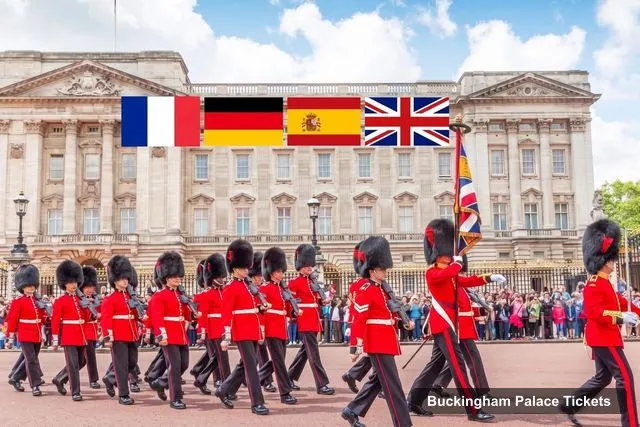
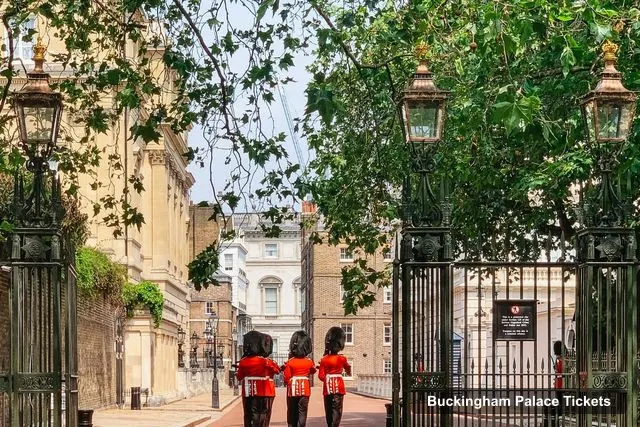
The Changing of the Guard is a different event with its own times: Wikipedia says it takes place daily from April to July and every other day in other months. Dates and times change, so use my Buckingham Palace opening hours guide and the official site, royal.uk, before you plan around it.
14 Buckingham Palace Facts With Sources
Here is the short list of Buckingham Palace facts to keep, in the order of the story.
Buckingham House was built in 1703 for the 1st Duke of Buckingham and Normanby (Wikipedia).
The Ballroom is 120 feet (36.6 m) long (Wikipedia).
The palace was bombed nine times in the Second World War (Wikipedia).
The State Rooms opened to the public in 1993 (Wikipedia).
683,000 people visited the palace in the year to 31 March 2025 (Wikipedia).
See the Buckingham Palace Facts in Person
A guide helps most outside the palace, where the history is told in the buildings and streets around it. My pick for a first visit is the Buckingham Palace and Changing of the Guard tour: $24, rated 4.5 from 2,694 reviews, about 2 hours on foot, with a guide.
Secret Chamber Tours Ltd
Buckingham Palace & Changing of the Guard Tour
★4.5 (2,694 reviews)
2 hours
Free cancellation
My pick: The most-reviewed guided tour: $24, 4.5 from 2,694 reviews, about 2 hours with a guide.
What you get, where you meet, what reviewers say
Included
✓ Guide
✓ Walking tour
Not included / not suitable
✕ Food and drinks
✕ Tips
✕ Entry to attractions
Meeting point: • Meet your guide at the Goddess Diana fountain at the Ritz Corner entrance of Green Park
• Enter Green Park via the entrance next to the Ritz Hotel and the fountain can be found just a few steps down the footpath, next to the Colicci refreshment stand. This is not the Diana Memorial Fountain in Hyde Park
• If taking the Underground, disembark at Green Park Station and take the Green Park/Buckingham Palace exit. This exit will lead you to the fountain Green Park (Stop H, London W1J 9DZ, UK
Languages: English
Duration: 2 hours
Cancellation: Cancel up to 24 hours in advance for a full refund
“Alan was the best guide and we were grateful to have him get us to all the right places at the right times!” – GetYourGuide review
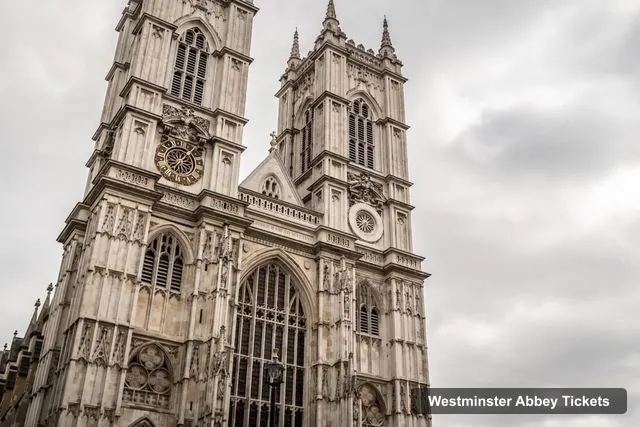
For a longer day that links the palace to Westminster, the Buckingham Palace, Westminster Abbey and Big Ben tour is $91, rated 4.8 from 1,311 reviews, about 5 hours, with a pre-booked Abbey ticket.
Top Sights Tours LLC.
Buckingham Palace, Westminster Abbey & Big Ben Tour
★4.8 (1,311 reviews)
5 hours
Free cancellation
My pick: The long day: $91, 4.8 from 1,311 reviews, 5 hours, Westminster Abbey entry included.
What you get, where you meet, what reviewers say
Included
✓ Walking tour
✓ Local guide
✓ Westminster Abbey pre-booked entry ticket
Not included / not suitable
✕ Entry to Buckingham Palace or Big Ben
Meeting point: We meet outside of the Ritz hotel (150 Piccadilly, W1J 9BR) next to 2 red telephone boxes and 2 souvenir stands, underneath one of the Ritz signs. The nearest tube station is Green Park Underground station. When you get to Green Park Underground station, take the left hand exit. You will see a set of stairs and a ramp leading out of the station. Take the stairs up and walk towards the Ritz Hotel. 150 Piccadilly, St. James's, London W1J 9BR, UK
Languages: English
Duration: 5 hours
Cancellation: Cancel up to 24 hours in advance for a full refund
“The tour provided a great introduction to the highlights of Westminster. We especially enjoyed our guide, Ash, who included interesting historic stories and kept us thoroughly engaged despite the bad weather!” – GetYourGuide review
Wikipedia says Buckingham House was built in 1703 for John Sheffield, 1st Duke of Buckingham and Normanby, to a design by William Winde. George III bought it in 1761, and George IV decided in 1826 to turn it into a palace with the architect John Nash. Queen Victoria was the first monarch to live there, from 1837.
How many rooms does Buckingham Palace have?+
Wikipedia counts 775 rooms, including 188 staff bedrooms, 92 offices, 78 bathrooms, 52 principal bedrooms and 19 state rooms.
How big is Buckingham Palace?+
According to Wikipedia the palace is 355 feet (108 m) across, 390 feet (120 m) deep and 80 feet (24 m) high, with a floor area of over 830,000 square feet (77,000 square metres). Its garden is 39 acres (16 hectares), described as the largest private garden in London.
When did Buckingham Palace open to the public?+
Wikipedia says the State Rooms were opened to the public in 1993. The King's Gallery, on the site of the chapel destroyed in 1940, opened in 1962. Check the official site, royal.uk, for the dates the State Rooms are open.
Does the King live at Buckingham Palace?+
Wikipedia says that after Charles III acceded in 2022 he lives at Clarence House but conducts official business at the palace, which remains the official residence and administrative headquarters of the monarch.