Musée d’Orsay facts are easiest to remember when you know the building was a railway station first. This page gives the dated story, from the station of 1898 to the museum of 1986, then 13 facts with a source for each. I wrote it from Wikipedia and Wikidata and I give numbers exactly as those sources do, including the places where they disagree. If you already want to go in, my page on tickets for the Musée d’Orsay compares every ticket and tour I found, with prices and ratings.
Musée d’Orsay History Timeline
Year
What happened
1898 to 1900
The Beaux-Arts railway station is built, in time for the 1900 Exposition Universelle
1970
Permission is granted to demolish the station; the minister rules against a planned hotel
1978
The station is listed; a competition for the conversion goes to ACT Architecture
1981
Gae Aulenti is chosen to design the interior
July 1986
The museum is ready
December 1986
President François Mitterrand officially opens it
2021
1.4 million visitors, per Wikipedia
2022
3.2 million visitors
2023
3.9 million visitors
Musée d’Orsay Facts About the Station
The museum is housed in the former Gare d’Orsay, which Wikipedia describes as a Beaux-Arts railway station built from 1898 to 1900. It was finished in time for the 1900 Exposition Universelle. Wikipedia says the station was designed by Lucien Magne, Émile Bénard and Victor Laloux, and that a clock in the main hall was created by Victor Laloux. Wikidata lists Victor Laloux as the architect, which matches the longest-standing name on the building.
From Station to Museum
A railway station does not become a museum by accident. Wikipedia says that in 1970 permission was granted to demolish the station, but that the Minister for Cultural Affairs, Jacques Duhamel, ruled against a planned hotel on the site. The station was finally listed in 1978. The same year a competition for the conversion went to ACT Architecture (Colboc, Bardon and Philippon), for about 20,000 square metres of new floorspace. In 1981 Gae Aulenti was chosen to design the interior.
The museum was ready in July 1986 and was officially opened in December 1986 by then-president François Mitterrand, per Wikipedia. Many of the works shown had been held at the Galerie nationale du Jeu de Paume before the museum opened, which is how the collection arrived with Monet, Renoir and van Gogh already in it.
Musée d’Orsay Facts About the Collection
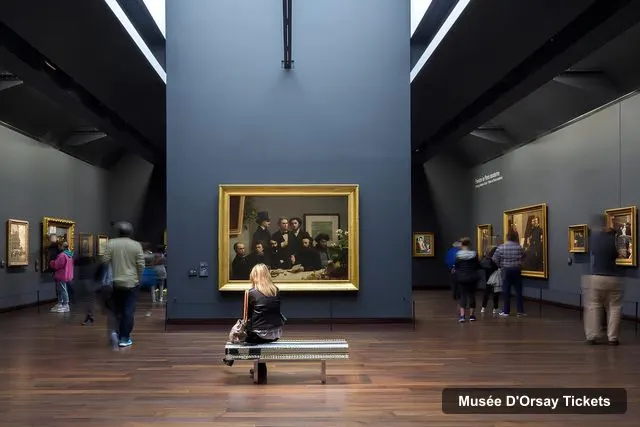
The museum holds mainly French artworks dating from 1848 to 1914, including paintings, sculptures, furniture and photography. Wikipedia says it houses the largest collection of Impressionist and post-Impressionist masterpieces in the world, by painters such as Monet, Manet, Renoir, Morisot, Degas, Sisley, Cézanne, Seurat, Gauguin and van Gogh. For the 1986 opening, about 2,000 paintings and 600 sculptures were installed, and about 3,000 art pieces are on display at any time. Wikipedia gives more than 2,200 sculptures today.
Musée d’Orsay Facts About Visitors
Wikipedia’s infobox gives 3.9 million visitors in 2023. It says there were 3.2 million visitors in 2022, up from 1.4 million in 2021, and that this made the Musée d’Orsay the sixth-most-visited art museum in the world in 2022 and the second in France after the Louvre. Wikidata gives a different figure for 2021, 1,044,365 visitors a year, so I use the Wikipedia numbers for the trend and note the gap here. The size of the crowd is the practical reason I check the Musée d’Orsay opening hours guide before a visit.
Musée d’Orsay Facts That Help You Plan the Visit
Some Musée d’Orsay facts matter more on the day than the dates do. The building that was designed to move crowds of travellers is now good at moving crowds of visitors, but with 3.9 million visitors in 2023 a timed slot is still sensible. The listings I compare show how people book: the guided tours run from 1.5 to 2.5 hours and start around $45 to $105, and one listing combines an entry ticket with a Seine river cruise at $47. The theatrical guided tour in French is the cheapest at $45 and is in French only, so it only suits you if you speak the language.
One more Musée d’Orsay fact worth knowing is the age of the art. The collection runs from 1848 to 1914, and the building dates from 1898 to 1900, so the museum is a late nineteenth-century collection in a late nineteenth-century hall. These Musée d’Orsay facts also explain why the station hall, not only the paintings, is worth a look. That is also why the station hall, with the clock Laloux created, is part of the show and not just a wrapper around the paintings.
Musée d’Orsay History in One Paragraph
If you only remember one paragraph of Musée d’Orsay history, make it this one. A station opened in 1900 for the world’s fair, lost its role, was nearly replaced by a hotel after the demolition permission of 1970, was listed in 1978, was converted by a team led first by ACT Architecture and then by Gae Aulenti for the interior, and was opened by President Mitterrand in December 1986 with about 2,000 paintings and 600 sculptures. Everything since is about the crowds: 1.4 million in 2021, 3.2 million in 2022 and 3.9 million in 2023, according to Wikipedia.
13 Musée d’Orsay Facts With Sources
The building is a Beaux-Arts railway station built from 1898 to 1900 (Wikipedia).
It was finished in time for the 1900 Exposition Universelle (Wikipedia).
The station was designed by Lucien Magne, Émile Bénard and Victor Laloux (Wikipedia).
Wikidata lists Victor Laloux as architect (Wikidata).
Permission to demolish the station was granted in 1970 (Wikipedia).
The sources I used do not say when long-distance trains stopped using the station, and I did not find the names of the 1986 decision-makers beyond Mitterrand’s opening, so I leave those out. Wikipedia’s page also does not tell you which painting is the most famous; the question comes up in searches, but a ranking of paintings is a matter of taste, not a fact I can source. For which floors hold which artists, see my Musée d’Orsay map. Check the official site at musee-orsay.fr for current rooms and closures.
See the Musée d’Orsay Facts in the Galleries
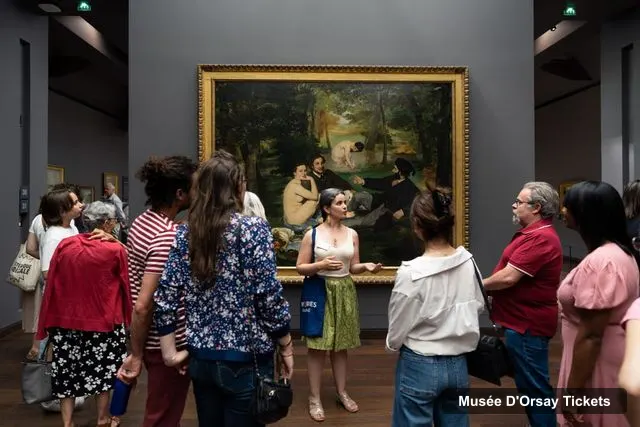
A guide is the quickest way to connect these Musée d’Orsay facts to the paintings. My pick for the most-reviewed guided visit is the Guided Tour with an Expert at $71, rated 4.8 from 1,257 reviews, which runs 1.5 to 2.5 hours.
Memories France
Musée d'Orsay: Guided Tour with an Expert
★4.8 (1,257 reviews)
1.5 - 2.5 hours
Free cancellation
My pick: The most-reviewed guided tour: $71, 4.8 from 1,257 reviews, 1.5 to 2.5 hours.
What you get, where you meet, what reviewers say
Included
✓ 1 hour 45 minutes guided tour of the Musée d’Orsay
✓ Fully accredited local guide
✓ Dedicated entrance and all entrance fees
✓ Headsets when appropriate so you can always hear your guide
✓ Stay as long as you like in the museum after your tour
Not included / not suitable
✕ Hotel pick-up/drop-off
✕ Gratuities (optional)
Meeting point: Meet your guide opposite the main entrance to the Musée d'Orsay, next to the entrance of the Legion d'Honneur Museum.
Your guide will be just by the entrance and will be wearing their guide badge on an orange lanyard.
Please do not get in the lines for the museum!
Nearest stations: RER Station Musée d’Orsay (Line C) or metro Solferino (line 12). 2 Rue de la Légion d'Honneur, 75007 Paris, France
Languages: English
Duration: 1.5 - 2.5 hours
Cancellation: Cancel up to 24 hours in advance for a full refund
“It was a wonderful excursion!Antonio was a perfect guide !Thank you !” – GetYourGuide review
If Impressionism is what you came for, the Guided Tour of Impressionism with Ticket Included is $70, rated 4.8 from 166 reviews, and takes about 1.5 hours.
Shedlight
Musée d'Orsay: Guided Tour of Impressionism with Ticket Included
★4.8 (166 reviews)
1.5 hours
Free cancellation
My pick: The Impressionism-focused tour: $70, 4.8 from 166 reviews, ticket included.
What you get, where you meet, what reviewers say
Included
✓ Welcome by the live guide at the meeting point
✓ Admission ticket to the Musée d’Orsay
✓ 1.5-hour guided tour
Not included / not suitable
✕ Food and drinks
✕ Transportation to the museum
Meeting point: The guide will be waiting for visitors right in front of the Legion of Honor Museum, which is opposite the Musée d'Orsay. Esplanade Valéry Giscard d'Estaing, 75007 Paris, France
Languages: French, English
Duration: 1.5 hours
Cancellation: Cancel up to 24 hours in advance for a full refund
“Our guide of Musée d’Orsay was excellent. We had been to this museum several times before, but she was able to tell us things about the impressionist paintings that were completely new to us.” – GetYourGuide review
What was the Musée d'Orsay before it was a museum?+
A railway station. Wikipedia says the Gare d'Orsay is a Beaux-Arts station built from 1898 to 1900, finished in time for the 1900 Exposition Universelle, and that the museum is housed in it.
When did the Musée d'Orsay open?+
Wikipedia says it was ready in July 1986 and officially opened in December 1986 by then-president François Mitterrand. Wikidata gives 1986 as the opening year.
Who designed the Musée d'Orsay building?+
Wikipedia names Lucien Magne, Émile Bénard and Victor Laloux as the designers of the station, and Wikidata lists Victor Laloux as architect. Gae Aulenti was chosen in 1981 to design the museum interior.
How many people visit the Musée d'Orsay?+
Wikipedia gives 3.9 million visitors in 2023 and 3.2 million in 2022, which it says made it the sixth-most-visited art museum in the world that year and second in France after the Louvre.
What is the Musée d'Orsay most famous for?+
Wikipedia says it houses the largest collection of Impressionist and post-Impressionist masterpieces in the world, by painters such as Monet, Manet, Renoir, Morisot, Degas, Sisley, Cézanne, Seurat, Gauguin and van Gogh.