Paris Catacombs history is a story about stone first and bones second, and the timeline below puts the dates in order. I wrote this page from Wikipedia and the official site, and I give numbers exactly as those sources give them, including the spots where Wikipedia contradicts itself. After the timeline comes the story by period and 14 facts with a source each. To go underground, my page on Paris Catacombs tickets compares the three guided options I found.
Paris Catacombs History Timeline
Year
What happened
1774
A series of cave-ins in the quarry tunnels begins, including a house collapse on the rue d’Enfer
1777
An inspector general of quarries is appointed in April
31 May 1780
A basement wall next to the Holy Innocents’ Cemetery collapses under a mass grave
1782
Passageways are renovated for their future role as a sepulchre
Late 1785
The plan to use the tunnels as an underground sepulchre becomes law
1787
The Count of Artois, later Charles X, makes an early visit
1810
Louis-Etienne Hericart de Thury takes charge of the Mine Inspection Service and renovates the ossuary
1833
The catacombs are closed completely
1850
Four visits a year are allowed again
1867
Monthly visits begin
1874
Bi-weekly visits begin and public visitation is established
June 1944
The Resistance uses the tunnels as headquarters
2009
Closed in September after vandalism; reopened on 19 December
2013
Becomes one of the fourteen City of Paris Museums
2026
Renovation with new lighting, ventilation, restored bone walls and audio guides
Paris Catacombs History: The Quarries Underneath
The tunnels were there before the bones. Wikipedia says the stone is Lutetian limestone, extracted in suburban locations that the city later grew over, using a method dating from after the 12th century: dig a well down to the deposit and extract the stone horizontally. As Paris grew, buildings ended up on top of empty galleries.
That became a problem in the 1770s. Wikipedia says a series of cave-ins began in 1774, among them a house collapsing on the rue d’Enfer, and that Louis XVI commissioned an investigation. The article dates the collapse to 1777 in another passage and links it to the appointment of an inspector general of quarries that April, so I would say simply that the cave-ins of the 1770s led to the project.
Paris Catacombs History: A City Running Out of Graves
The second problem was above ground. The Saints-Innocents cemetery was the largest source of remains, with about 2 million people buried there over 600 years according to Wikipedia, and a central burial ground that formed a mound about two metres high. On 31 May 1780 a basement wall next to the cemetery collapsed under the weight of a mass grave. Burials inside the city were forbidden after 1780.
The quarries offered a solution. The passageways were renovated in 1782 for their new role, and in late 1785 the plan to use them as an underground sepulchre became law. Wikipedia is not consistent on what followed. Its introduction says nightly wagon processions of bones began in 1788, while the history section ties an opening ceremony to 1785 or 1786. Transfers went on for a long time, and the article says it would take two years to empty the majority of Paris’s cemeteries. Besides Saints-Innocents, it names Saint-Etienne-des-Gres, Madeleine, Errancis and Notre-Dame-des-Blancs-Manteaux among the sources.
Paris Catacombs History in the Revolution and Empire
The ossuary kept growing through the Revolution. Wikipedia reports that 22 Girondists were executed on 31 October 1793 and that Charlotte Corday, who died on 18 July 1793, had her remains moved there later. The same year Philibert Aspairt, a door keeper at Val-de-Grace, died in the catacombs, and his body was found in 1804, 11 years later.
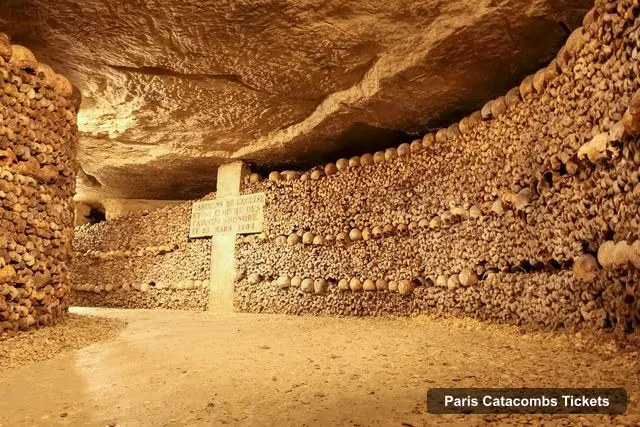
In 1810 Louis-Etienne Hericart de Thury became director of the Mine Inspection Service. Wikipedia credits him with the renovations that turned the ossuary into a visitable mausoleum, and the entrance inscription Arrete! C’est ici l’empire de la Mort, meaning Stop! The empire of Death lies here, belongs to that image. If you want to see how the route runs today, my Paris Catacombs map page walks through it.
Paris Catacombs History: From Restricted Visits to Museum
Public access was slow to arrive. Permission-only visits were restored in 1830 after crowds had degraded the ossuary, and the catacombs were closed completely in 1833 because of church opposition. Four visits a year were allowed from 1850, monthly visits from 1867, and bi-weekly visits on the first and third Saturdays from 1874, when public visitation was established. Wikipedia adds weekly visits during the World’s Fairs of 1878, 1889 and 1900.
In June 1944 members of the Resistance used the tunnels as headquarters for the insurrection that led to the liberation of Paris. In September 2009 the catacombs closed after vandalism and reopened on 19 December. They became one of the fourteen City of Paris Museums, managed by Paris Musees, in 2013. The site had 480,000 visitors in 2018, per Wikipedia, and renovations in 2026 include new lighting and ventilation, restored bone walls and new audio guides.
Paris Catacombs History Today: What You Walk Through
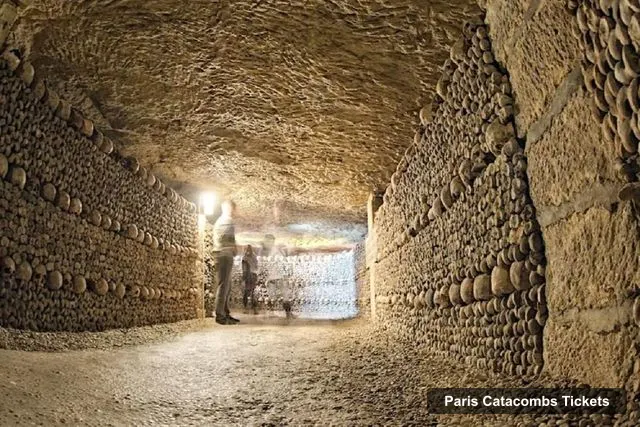
The official site describes a one-way circuit of 1.5 kilometres, with 131 steps down and 112 up, a constant 14 degrees Celsius and a cap of 200 visitors at a time. I cover those practical rules in my Paris Catacombs opening hours guide, which also explains the timed slots. The ossuary part is only a section of the route, and much of the walk is through the old quarry galleries.
That mix is what makes the Paris Catacombs history easy to read on the ground. You go down into the stone that built the city, you pass the galleries that were once at risk of collapse, and then you reach the walls of bones that the 18th century moved there. The audio guides and signs follow the same order, and a guided tour usually adds names and dates from the Paris Catacombs history that the signs leave out. I would not try to cover everything in one visit. If the story interests you, read the timeline above before you go, so that the room-by-room details have something to attach to, and keep in mind that the official site and Wikipedia sometimes disagree on early dates.
14 Paris Catacombs Facts With Sources
The ossuary holds the remains of more than six million people (Wikipedia).
About 2 million people were buried at the Saints-Innocents cemetery over 600 years (Wikipedia).
The stone quarried here is Lutetian limestone (Wikipedia).
A cave-in series began in 1774 and led Louis XVI to commission an investigation (Wikipedia).
A wall collapsed next to the Holy Innocents’ Cemetery on 31 May 1780 (Wikipedia).
All burials inside the city were forbidden after 1780 (Wikipedia).
The plan for an underground sepulchre became law in late 1785 (Wikipedia).
The catacombs were closed completely in 1833 (Wikipedia).
Public visitation was established in 1874 (Wikipedia).
The Resistance used the tunnels as headquarters in June 1944 (Wikipedia).
The site reopened on 19 December 2009 after vandalism (Wikipedia).
The visitor circuit is 1.5 kilometres, with 131 steps down and 112 steps up (official site).
Visitor numbers are capped at 200 at a time, and the temperature stays at 14 degrees Celsius (official site).
I did not find a Wikidata entry that matched the Catacombs in my data, so none is used here. Wikipedia gives no figure for the total length of the quarry network in the text I read, so I do not quote one.
See Paris Catacombs History With a Guide
Much of what makes this place memorable is the story behind it, and a guide supplies that. The tour I would look at first is the skip-the-line guided tour with special access: $155, 4.8 stars from 424 reviews, 1.5 hours. Note that this listing is non-refundable.
ExperienceFirst
Paris Catacombs Skip-the-Line Guided Tour and Special Access
★4.8 (424 reviews)
1.5 hours
My pick: The best-reviewed guided tour: $155, 4.8 from 424 reviews, skip-the-line entry and special access, 1.5 hours, non-refundable.
What you get, where you meet, what reviewers say
Included
✓ Skip-the-line entry ticket to the Paris Catacombs
✓ VIP access to areas not available to the general public
✓ English-speaking guide
✓ Optional upgrade for a narrated Seine River cruise, good for a year from the tour date
Not included / not suitable
✕ Gratuities
Meeting point: From Metro station Denfert Rochereau (line 4 or 6), use Exit 1 to reach the street level. You’ll see the Catacombs entrance, with glass doors and a sign, across the street, located to the right of the small green building that was the former entrance.
Your guide will be waiting with an orange "ExperienceFirst" sign. 1 Avenue du Colonel Henri Rol-Tanguy, 75014 Paris, France
Languages: English
Duration: 1.5 hours
Cancellation: This activity is non-refundable
“Liz was such a awsome knowledgeable guide. 10/10 recommended” – GetYourGuide review
If you want the restricted rooms, the other 4.8 option is $199 from 85 reviews.
the tour guy
Paris Catacombs Guided Tour With Restricted Rooms
★4.8 (85 reviews)
1.5 hours
Free cancellation
My pick: The restricted-rooms pick: $199, 4.8 from 85 reviews, 1.5 hours.
What you get, where you meet, what reviewers say
Included
✓ Expert, English-speaking guide
✓ Timed-entry Paris Catacombs tickets
✓ Access to 2 restricted chambers
✓ Visit to the Barrel of Passion in the Crypt of Passion
✓ Exploration of the lower Catacombs
Not included / not suitable
✕ Guide tips
Meeting point: Please arrive 15 minutes early. Your guide will meet you in front of Café Oz (3 Place Denfert-Rochereau), near the exit of the Denfert-Rochereau Metro. A representative will be there holding a sign with 'The Tour Guy' on it. 3 Pl. Denfert-Rochereau, 75014 Paris, France
Languages: English
Duration: 1.5 hours
Cancellation: Cancel up to 24 hours in advance for a full refund
“easy check in and organized tour guide very informative” – GetYourGuide review
Wikipedia says the ossuary was a response to two problems: cave-ins in old quarry tunnels under the city from 1774, and overflowing cemeteries. After a basement wall next to the Holy Innocents' Cemetery collapsed under a mass grave on 31 May 1780, burials inside the city were forbidden and the remains were moved to the old quarries.
Who is buried in the Paris Catacombs?+
Wikipedia says the ossuary holds the remains of more than six million people. The largest source was the Saints-Innocents cemetery, where about 2 million people were buried over 600 years. Charlotte Corday's remains were later moved there, and 22 Girondists executed on 31 October 1793 are also mentioned.
When did the Paris Catacombs open to the public?+
Wikipedia says the ossuary was opened to public visitation from 1874, after a history of permission-only visits, a full closure in 1833 and four visits a year from 1850. Monthly visits began in 1867 and bi-weekly visits in 1874.
What was the Paris Catacombs' role in World War II?+
Wikipedia reports that in June 1944 members of the Resistance used the tunnels as headquarters for the insurrection that led to the liberation of Paris.
What is written at the entrance of the Paris Catacombs?+
Wikipedia gives the inscription as Arrete! C'est ici l'empire de la Mort, meaning Stop! The empire of Death lies here.
Why were the Paris Catacombs closed in 2009?+
Wikipedia says that after vandalism the catacombs closed in September 2009 and reopened on 19 December. It also records renovation work in 2026 with new lighting and ventilation, restored bone walls and new audio guides.