The Natural History Museum London map looks complicated until you see that the building is one long Victorian hall with wings on each side. Entry to the permanent galleries is free, per the official visit page, so the real question is where to spend your hours. This page gives the Natural History Museum London map of the area and the building, then the route I would take, one stop at a time. If you want a guide or an audio tour with reserved entry, my comparison of tickets for the Natural History Museum London shows every option.
Natural History Museum London Map: Entrances, Stations and Sights
The map below shows the museum with its nearest stations and the landmarks around it, from Google Maps data.
Kensington Gardens · Nearby sight · about 19 min walk
The address is Cromwell Road, South Kensington, London SW7 5BD. South Kensington is the nearest Tube station, about 5 minutes on foot by my estimate, and Gloucester Road is about 8 minutes. The walking times are straight-line distance multiplied by 1.3 at 4.8 km per hour, so treat them as estimates. The Victoria and Albert Museum is next door on Exhibition Road, and the Science Museum is close by, which is why the East Entrance side of the street is busy.
There are three entrances, per the museum’s visual guide: Central on Cromwell Road, East on Exhibition Road and West on Queen’s Gate, which is open until 17:00. The Central Entrance is ramped. For self-propelled wheelchairs the museum suggests the East or West entrances, because they have lifts. Many tours meet on Exhibition Road or opposite the main door, so read your voucher before you head for the Cromwell Road steps.
The Official Natural History Museum London Map
The museum offers a free official museum map (PDF) from its galleries and museum map page. I link it and do not copy it, because galleries close and move. The page groups the galleries by wing, so I use the same names below, and I suggest you keep that Natural History Museum London map open on your phone. Some older maps and travel sites talk about colour zones, which I could not find on the current official pages, so I do not rely on them.
The Route I’d Take Inside the Natural History Museum London
This route runs from the central hall through the dinosaurs, then the East Wing, the North Wing and the West Wing, with the gardens last. It is my answer to what to see inside Natural History Museum London in the order a tired visitor can manage. I leave out times on the diagram because the museum gives no time per gallery.
My route inside the Natural History Museum
1Central EntranceCromwell Road, ramped
2Hintze HallHope the blue whale
3Dinosaur GalleryCentral Building
4Earth HallEast Wing, Stegosaurus and the globe
5Mammals HallNorth Wing, blue whale model
6The CocoonWest Wing, Darwin Centre
7The gardensFern the Diplodocus and the Evolution Timeline
Hintze Hall and Hope the Blue Whale
Hintze Hall is the first thing you see and the reason many people come. Wikipedia says the former Central Hall now houses the blue whale skeleton and a giant sequoia, per Wikipedia. The whale, named Hope, is about 25 metres long and weighs 4.5 tonnes. It replaced the Diplodocus replica nicknamed Dippy in 2017. The museum lists the Hintze Hall Balconies in the Central Building as a place to see the whale from above, so take the stairs for a second view.
I would stay about ten minutes. It is the best orientation point for the Natural History Museum London map, because every wing leads off the hall.
The Dinosaur Gallery
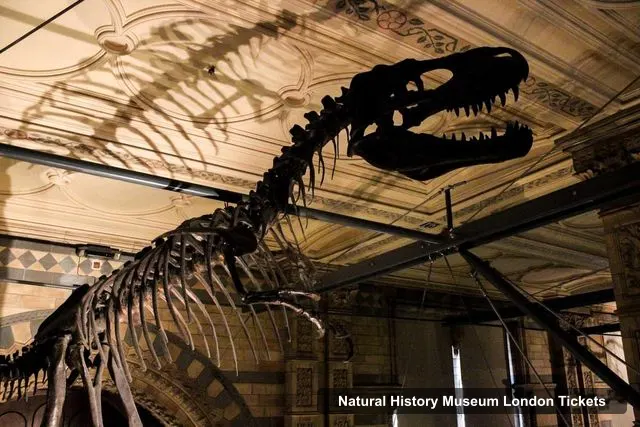
The Dinosaur Gallery is in the Central Building, per the museum, and it is the busiest room of the day for families. Go here straight after the hall, and mark it on your Natural History Museum London map, before the school groups arrive in force. The museum says visitor numbers are usually higher in the mornings and at weekends, and lower on weekday afternoons, so an afternoon visit on a weekday suits this room better. A guide helps because the gallery is crowded and the panels are many.
Babylon Tours London
Natural History Museum Guided Tour
★4.9 (96 reviews)
2.5 hours
Free cancellation
My pick: The longest guided option: $117, 2.5 hours, 4.9 stars from 96 reviews, with a guide who walks the main galleries.
What you get, where you meet, what reviewers say
Included
✓ Professional art historian guide
✓ Private and semi-private options
Not included / not suitable
✕ Gratuities (optional)
✕ Hotel pick-up and drop off
✕ Food and drinks
✕ Temporary exhibits
Meeting point: Meeting point may vary depending on the option you select. Check availability for more details.
Languages: English
Duration: 2.5 hours
Cancellation: Cancel up to 24 hours in advance for a full refund
“Very knowledgeable and helpful guide. Matilda was great!” – GetYourGuide review
The museum lists Earth Hall with the Stegosaurus, the Enigmacursor on the Earth Hall Mezzanine, Volcanoes and Earthquakes, and From the Beginning in the East Wing. Wikipedia adds that visitors ride an escalator up through a model of the Earth made of plates, and that Sophie the Stegosaurus, shown since December 2014, is described as the most complete Stegosaurus skeleton ever found. The East Wing has lifts, and the East Entrance on Exhibition Road is the shortest way in if this is your first stop. On the Natural History Museum London map this wing is on the east side. Allow 30 to 40 minutes if you ride the escalator and visit the volcano rooms.
Mammals Hall in the North Wing
The North Wing holds Mammals Hall with a blue whale model, Marine Invertebrates, and Fishes, Amphibians and Reptiles, according to the museum. The visual guide says the lift to the Mammals Hall balcony was out of service on the museum’s page, so plan for stairs and check the official page on the day. Children tend to like the whale model because it is life size, and it makes a useful contrast with the skeleton in Hintze Hall.
The Cocoon in the West Wing
The Cocoon is in the Darwin Centre in the West Wing. Wikipedia says the Darwin Centre’s second phase, an eight-storey cocoon designed by C. F. Møller Architects, opened to the public in September 2009 and holds the entomology and botanical dry collections. It is the quietest wing on most days, and the West Entrance on Queen’s Gate is the way in if you want to start here. A tour built around the museum’s ancient creatures is the cheapest way to add context.
Vox Londoners
Natural History Museum Ancient Monsters Guided Tour
★4.5 (37 reviews)
1.5 hours
Free cancellation
My pick: A shorter, cheaper guided option: $27, 1.5 hours, 4.5 stars from 37 reviews, themed on ancient monsters.
What you get, where you meet, what reviewers say
Included
✓ Skip-the-line access
✓ 3-hour in-depth guided experience
✓ Tyrannosaurus rex
✓ Stegosaurus
✓ Diplodocus and other prehistoric giants
✓ Ancient predators and marine reptiles
Meeting point: I look forward to meeting you opposite the Natural History Museum, outside the Embassy of Venezuela, 1 Cromwell Rd, South Kensington, London SW7 2JB. We will then make our way towards the Natural History Museum 1 Cromwell Rd, South Kensington, London SW7 2HW, UK
Languages: English
Duration: 1.5 hours
Cancellation: Cancel up to 24 hours in advance for a full refund
“Good. Just about an hour! Very knowledgeable and friendly” – GetYourGuide review
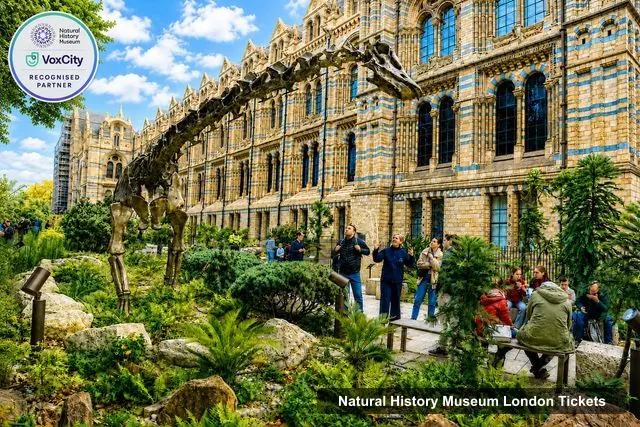
The museum’s gardens hold Fern the Diplodocus and the Evolution Timeline, and the visual guide calls the Nature Discovery Garden usually the quietest. It is a good last stop when the galleries are full, and it is on the Natural History Museum London map as a separate area. The Wildlife Garden is on the west lawn, per Wikipedia, and I could not confirm its current opening season, so check the museum’s site before you plan around it.
Getting Around Inside the Natural History Museum London
Lifts serve the East and West entrances, the East Wing, the Central Building beside the stairs, the West Wing and the picnic area, per the museum’s visual guide. Cloakrooms are near the security desk at the Central Entrance and near the registration desk at the East Entrance. The building has a lot of stairs and long corridors, so a Natural History Museum London map helps more than you expect, so wear comfortable shoes and keep a map on your phone.
Is there an official Natural History Museum London map?+
Yes. The museum offers a downloadable museum map as a PDF on its website, and I link it on this page without copying it. The museum's pages also group the galleries by wing, so the map and the wing names are the best way to find a gallery.
What is inside the Natural History Museum in London?+
Inside you find Hintze Hall with the blue whale skeleton named Hope, the Dinosaur Gallery, Earth Hall and the Volcanoes and Earthquakes galleries in the East Wing, Mammals Hall in the North Wing, the Cocoon in the West Wing, and gardens outside.
How many wings and zones does the Natural History Museum have?+
The museum's visual guide lists five areas: the East Wing, Central Building, North Wing, West Wing and the Museum Gardens. Some older maps and websites use colour zones, which I could not confirm on the current official pages, so I use the wing names.
Which entrance should I use at the Natural History Museum?+
There are three: Central on Cromwell Road, East on Exhibition Road and West on Queen's Gate, open until 17:00. The Central Entrance is ramped, and the museum suggests the East or West entrances for self-propelled wheelchair users because they have lifts.
How long do you need inside the Natural History Museum?+
The guided tours I compared run from 30 minutes to 3 hours, and most take 1.5 to 2.5 hours. I would allow 3 hours for the route on this page, which is my own estimate and not an official figure.