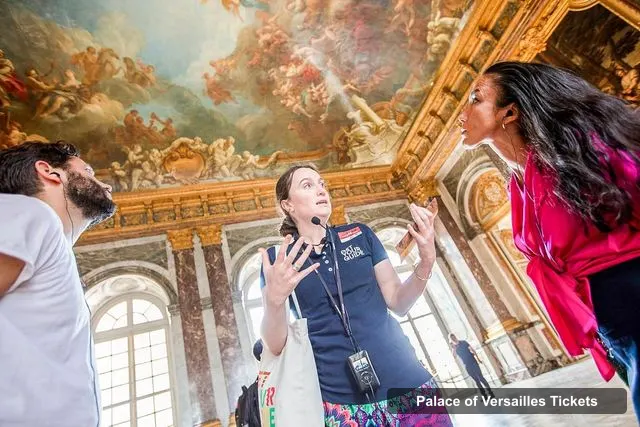
The Palace of Versailles history begins with a hunting lodge, and the dates in this page show how a small royal retreat became the seat of the French court. I wrote it from Wikipedia, Wikidata and the official site, and I give numbers exactly as those sources give them. First comes a timeline, then the story by period, then 14 facts with the source for each. If you already know you are going, my page with every option for Palace of Versailles tickets compares all 7 on price and what they include.
Palace of Versailles History Timeline
Year
What happened
1623
Louis XIII builds a hunting lodge about 19 km west of Paris
1631 to 1634
Philibert Le Roy replaces the lodge with a château
1661
Mazarin dies; Louis XIV sees Fouquet’s festival at Vaux-le-Vicomte and starts planning Versailles
1668 to 1671
Le Vau’s enlargement wraps around Louis XIII’s château on three sides
1678
Jules Hardouin-Mansart becomes First Architect
1682
The court and government move to Versailles
1699 to 1710
The palace chapel is built
1715
Louis XIV dies at Versailles on 1 September
1748 to 1770
The Royal Opera is built
1783
The Peace of Paris treaties are signed at Versailles
1789
The Women’s March on Versailles on 5 October; the royal family leaves for Paris the next day
1793
The monarchy is abolished and the auction of royal property begins on 25 August
1837
The Museum of the History of France is inaugurated on 30 June
1871
The German Empire is proclaimed in the Hall of Mirrors on 18 January
1919
The Treaty of Versailles is signed in the Hall of Mirrors
1979
The palace and park are inscribed as a UNESCO World Heritage Site
2006
Restoration of the Hall of Mirrors is completed
Palace of Versailles History: From Hunting Lodge to Château
Wikipedia traces the name back to a charter of the Abbey of Saint-Père de Chartres from 1038, but the story of the palace starts in 1623, when Louis XIII built a hunting lodge about 19 km west of Paris. That first building was small, about 35 metres long per Wikipedia. Between 1631 and 1634 Philibert Le Roy replaced it with a château. In 1630 the lodge had already been the setting for the Day of the Dupes, the day Cardinal Richelieu regained the king’s favour.
Louis XIII died in 1643 and the château was left alone for about a decade, as the regent Anne of Austria kept the court elsewhere. Nothing in the Palace of Versailles history of those years points to what came next. It took a young king and a rival’s party to change that.
Palace of Versailles History Under Louis XIV
The turning point is 1661. Wikipedia reports that after Mazarin died, Louis XIV attended a festival at Vaux-le-Vicomte, the estate of his finance minister Nicolas Fouquet, on 17 August, and that the event led him to start planning Versailles. In 1664, 1668 and 1674 he held nighttime festivals in the gardens, and from 1668 to 1671 Louis Le Vau’s enlargement, which Wikipedia calls an “enveloppe”, encased Louis XIII’s château on three sides.
Money and war shaped the schedule. The Franco-Dutch War began in 1672 and funding was cut until 1674. After the French victory in 1678, Jules Hardouin-Mansart became First Architect, and the Hall of Mirrors was added in those years; Wikipedia gives slightly different dates for it in different sections, with 1678 to 1681 among them. The court and government moved to Versailles in 1682, and the king’s permanent residence there began on 6 May 1682. A new town was laid out beside the palace, with land granted to courtiers for townhouses from 1671.
The building work did not stop with the move. The north wing was built from 1685 to 1689, the Nine Years’ War halted work from 1688 until 1698, and the palace chapel followed between 1699 and 1710. Louis XIV died at Versailles on 1 September 1715, which ended the longest chapter of the Palace of Versailles history as a building site.
Palace of Versailles History Under Louis XV and Louis XVI
After the Regency years, the court returned to Versailles in 1722. Wikipedia records the completion of the ceiling painting in the Salon of Hercules in 1736, the start of the Royal Opera in 1748 (finished in 1770) and, in 1771, Gabriel’s rebuilding of the northern Ministers’ Wing in Neoclassical style. The article also notes that Mozart visited at Christmas in 1763.
Versailles was also a place of diplomacy. In 1783 the Peace of Paris treaties were signed there, with Spain and France signing with Britain on 4 September. The Opera and the Hall of Mirrors are worth a look with that in mind, and my Palace of Versailles map page shows where they sit inside.
Palace of Versailles History in the French Revolution
On 14 July 1789 the king and queen learned of the Storming of the Bastille. On 5 October the Women’s March on Versailles took place, and on 6 October the royal family left for Paris. Wikipedia says the court never returned.
The palace was emptied in the following years. In 1792 paintings and sculptures were moved to the Louvre. In 1793 the monarchy was abolished and the auction of the royal property began on 25 August, which Wikipedia says ran to about 17,000 lots and ended on 11 August 1794. The empty grand apartments were opened for tours in 1793, so visitors have been walking through Versailles for more than two centuries. Napoleon considered making it his residence in 1804, abandoned the idea and restored the Grand Trianon before his 1810 marriage.
Palace of Versailles History: Museum, War and Treaty
In 1830 the July Revolution brought Louis Philippe I to power, and he turned the palace into a museum. The Museum of the History of France was begun in 1833 and inaugurated on 30 June 1837. Napoleon III hosted a banquet for Queen Victoria on 25 August 1855.
The Franco-Prussian War brought the most striking scene of the 19th century. German forces occupied the palace, and the German Empire was proclaimed in the Hall of Mirrors on 18 January 1871. Wikipedia adds that the Germans left after the March 1871 armistice, and that in late May the suppression of the Paris Commune was directed from Versailles. The same hall hosted the Treaty of Versailles in June 1919; Wikipedia gives 28 June 1919 in an image caption.
Private money paid for the rescue of the building between the wars. Wikipedia says John D. Rockefeller Jr. funded restoration work in 1925 to 1928 with a gift of $2,166,000, about $38 million in 2024 terms.
Palace of Versailles History Since 1945
The Royal Opera reopened in 1957. A bombing by Breton terrorists damaged parts of the palace in 1978, and in 1979 the palace and park were inscribed as a UNESCO World Heritage Site. In 1995 it became a Public Establishment. Cyclone Lothar struck on 26 December 1999 and, according to Wikipedia, destroyed more than 10,000 trees in the park. The “Grand Versailles” project began in 2003 and restoration of the Hall of Mirrors was completed in 2006. In 2024 the grounds hosted equestrian and modern pentathlon events at the Summer Olympics.
14 Palace of Versailles Facts With Sources
Louis XIII built a hunting lodge here in 1623, about 19 km west of Paris (Wikipedia).
Wikidata gives 1661 as the opening year and Louis Le Vau as the architect (Wikidata).
The court and government moved to Versailles in 1682 (Wikipedia).
The palace has a floor area of about 63,154 square metres and roughly 2,300 rooms (Wikipedia).
Its façade is 402 metres (1,319 ft) long (Wikipedia).
It has 2,143 windows, 1,252 chimneys and 67 staircases (Wikipedia).
The park covers 815 hectares today, against more than 8,000 hectares before the Revolution, and 93 hectares are formal gardens (Wikipedia).
Louis XIV died at Versailles on 1 September 1715 (Wikipedia).
The royal family left for Paris on 6 October 1789 and the court never returned (Wikipedia).
The 1793 to 1794 auction of royal property ran to about 17,000 lots (Wikipedia).
The Museum of the History of France was inaugurated on 30 June 1837 (Wikipedia).
The German Empire was proclaimed in the Hall of Mirrors on 18 January 1871 (Wikipedia).
The palace and park were inscribed by UNESCO in 1979, reference number 83, with an 800 hectare core area and a 9,467 hectare buffer zone (Wikipedia).
Wikidata records 8,132,518 visitors a year, counted in 2018 (Wikidata).
Walk Through the Palace of Versailles History
The Palace of Versailles history above sticks better when you stand in the rooms, and a guide is the easiest way to do that. A good guide also keeps the Palace of Versailles history in order as you move from the Hall of Mirrors to the apartments. The one I would pick for the history is the skip-the-line guided tour: $78, 4.7 stars from 2,621 reviews, 1.5 to 2 hours, with cancellation free up to 24 hours before.
GetYourGuide France
Palace of Versailles Skip-the-Line Guided Tour
★4.7 (2,621 reviews)
1.5 - 2 hours
Free cancellation
My pick: The best-reviewed guided tour: $78, 4.7 from 2,621 reviews, skip-the-line entry, free cancellation up to 24 hours before.
What you get, where you meet, what reviewers say
Included
✓ Skip-the-line entrance to the Palace of Versailles
✓ 90-minute guided tour of the palace
✓ November to March: Gardens access included with all options
✓ November to March: Marie Antoinette’s Estate access (included with "All Access" option only)
✓ April to October: Garden access with Musical fountain shows and Marie Antoinette’s Estate (included with "All Access" option only)
Not included / not suitable
✕ Transfers to/from Paris
Meeting point: Check in at the GetYourGuide shop (do not go directly to the Palace). Your guide will meet you at the shop and provide your tickets. 10 Av. du Général de Gaulle, 78000 Versailles, France
Languages: Japanese, Italian, German, Portuguese, Spanish, French, English
Duration: 1.5 - 2 hours
Cancellation: Cancel up to 24 hours in advance for a full refund
“Our guide was clear and knowledgeable. Easy to follow.” – GetYourGuide review
Louis XIII built a hunting lodge on the site in 1623, according to Wikipedia, and replaced it with a small château between 1631 and 1634. Louis XIV had it enlarged in several campaigns from 1661, and the court and government moved there in 1682. Wikidata gives 1661 as the opening year.
Who built the Palace of Versailles?+
Several architects over several reigns. Wikipedia names Philibert Le Roy for the château of the 1630s, Louis Le Vau for the enlargement that wrapped around it from 1668, and Jules Hardouin-Mansart, who became First Architect in 1678. Wikidata lists Louis Le Vau as the architect.
Why did Louis XIV move the court to Versailles?+
Wikipedia ties the project to the festival Nicolas Fouquet held for the king at Vaux-le-Vicomte on 17 August 1661, which led Louis XIV to start planning Versailles. The court and government moved there in 1682, and the king's permanent residence began on 6 May 1682.
What happened at Versailles during the French Revolution?+
On 5 October 1789 the Women's March on Versailles took place, and the royal family left for Paris the next day. Wikipedia says the court never returned. In 1793 the monarchy was abolished and the auction of the royal property began on 25 August.
Where was the Treaty of Versailles signed?+
In the Hall of Mirrors. Wikipedia gives 28 June 1919 in an image caption. The same article records that the German Empire had been proclaimed in the same hall on 18 January 1871, during the Franco-Prussian War.
Is the Palace of Versailles a UNESCO World Heritage Site?+
Yes. Wikipedia says the palace and park were inscribed in 1979, reference number 83, under cultural criteria i, ii and vi. The listing has an 800 hectare core area and a 9,467 hectare buffer zone.