Sacre-Coeur Basilica history is shorter than most Paris landmarks, but it is full of dates that people mix up: the vow, the cornerstone, the dome, the completion and the consecration are five different years. I took them from Wikipedia and give them as the article gives them, including the points where its own sections disagree. This page has a timeline, the story by period and 14 facts with sources. If you plan to go inside or climb the dome, my page on Sacre-Coeur Basilica tickets compares the five options I found.
Sacre-Coeur Basilica History Timeline
Year
What happened
4 September 1870
Bishop Felix Fournier proposes a church to the Sacred Heart after the defeat at Sedan
1871
A fundraising campaign based on private donations begins
July 1873
The National Assembly approves the project
16 June 1875
The cornerstone is laid
3 March 1876
A provisional chapel is consecrated
1884
The foundation is completed and Paul Abadie dies
1885
Perpetual adoration of the Blessed Sacrament begins
1891
The interior is completed, dedicated and opened for worship
1899
The dome is completed
1912
The bell tower is finished
1914
The basilica is completed
16 October 1919
The basilica is consecrated
1923
The apse mosaic is dedicated
1944
The bell rings during the Liberation of Paris on 24 August
2022
Designated a monument historique on 8 December
Sacre-Coeur Basilica History: The 1870 Vow
The church was born from defeat. Wikipedia says that on 4 September 1870, after France’s defeat at Sedan in the Franco-Prussian War, Bishop Felix Fournier of Nantes proposed a church in Paris dedicated to the Sacred Heart. Alexandre Legentil joined the effort in January 1871, and a fundraising campaign followed that relied entirely on private donations. The Paris Commune of 1871 sits in the same period, and the article places the project in that political climate, so the hill became a symbol both for supporters and for critics.
The National Assembly approved the project in July 1873. A design competition drew 77 proposals, per Wikipedia, and Paul Abadie won it. Sacre-Coeur Basilica history from this point is a story of building on a hill that is full of old gypsum workings. The foundations needed 83 wells, each 30 metres deep, and the article gives an early cost estimate of 7 million francs.
Sacre-Coeur Basilica History: Building Years
The cornerstone was laid on 16 June 1875 and a provisional chapel was consecrated on 3 March 1876. The foundation was completed in 1884, the year Paul Abadie died. Perpetual adoration of the Blessed Sacrament began in 1885, and the interior was completed, dedicated and opened for worship in 1891.
Politics threatened the project twice. In 1882 Georges Clemenceau’s left-wing coalition won the election and proposed halting construction, but the government had to allow work to continue: Wikipedia puts the liabilities if the project had been cancelled at 12 million francs. In 1897 Clemenceau’s attempt to block the completion was defeated in parliament, and the article says 30 million francs were owed to about 8 million contributors. The dome was completed in 1899, the bell tower in 1912 and the basilica in 1914.
Sacre-Coeur Basilica History: Stone, Bell and Mosaic
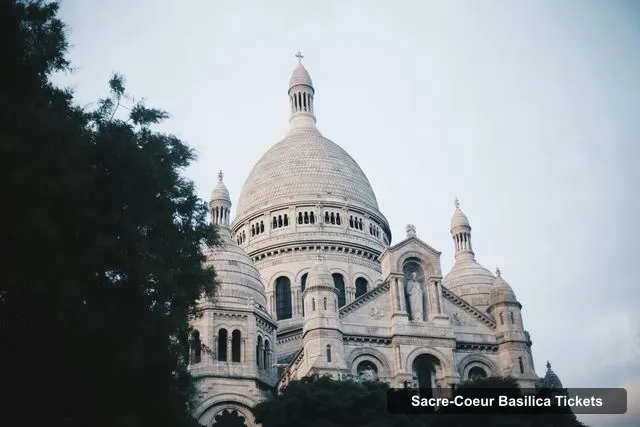
The stone explains the colour. Wikipedia says it is travertine limestone of the Chateau-Landon type, quarried at Souppes-sur-Loing in Seine-et-Marne. The dome is 83.33 metres high, the campanile 84 metres, and the dome stands about 200 metres above the Seine. The infobox gives 85 metres long, 35 metres wide and 83 metres high.
The Savoyarde bell weighs about 18,835 kilograms, with a diameter of 3.03 metres and an 850 kilogram clapper, and Wikipedia says it is audible from 10 kilometres away and is the fifth largest bell in Europe. The article gives two different casting dates, 1895 in one section and 13 May 1891 in another, so I would not quote either without checking the official site. The bell rang during the Liberation of Paris on 24 August 1944.
The apse mosaic, dedicated in 1923, has 25,000 pieces covering 475 square metres. The organ, installed in 1905 by Charles Mutin, has 109 ranks and 78 speaking stops over four 61-note manuals, and was recognised as a national landmark in 1981.
Sacre-Coeur Basilica History After the War
The basilica was consecrated on 16 October 1919, after the First World War. A bomb exploded inside the church in 1976. In 2004 the square in front of it was renamed for Louise Michel. A measure to give the basilica historic monument status was blocked by leftist parliamentarians and postponed in 2021, and it was formally designated a monument historique on 8 December 2022. Wikipedia calls it the second most visited tourist destination in Paris, after the Eiffel Tower, but gives no visitor count.
For today’s visit, the practical facts are on the official site: entry to the basilica is free from 6:30 am to 10:30 pm, and the dome has its own hours and an 8 euro adult ticket. I explain both in my Sacre-Coeur Basilica opening hours guide. Wikipedia lists slightly different hours (06:00 to 22:30), so use the official site for your date.
Reading Sacre-Coeur Basilica History on the Spot
Sacre-Coeur Basilica history is unusual because the whole story fits inside the lifetime of one family. A child born at the time of the 1870 vow could have seen the cornerstone, the dome and the consecration. That is why the building mixes styles and materials from different decades, and why guides tend to talk about money, politics and war as much as about architecture.
Here is how I would use the dates when you stand on the steps. Look at the white travertine and remember it came from Seine-et-Marne. Look at the dome and remember it was finished in 1899, fifteen years before the rest. Listen for the Savoyarde bell and remember the dates in the section above are not settled. Sacre-Coeur Basilica history rewards that kind of slow looking, and none of it costs anything outside the dome. If you go in, remember it is a working church, with Mass held through the day.
14 Sacre-Coeur Basilica Facts With Sources
Bishop Felix Fournier proposed the church on 4 September 1870 (Wikipedia).
The design competition had 77 proposals (Wikipedia).
The cornerstone was laid on 16 June 1875 (Wikipedia).
The foundations use 83 wells, each 30 metres deep (Wikipedia).
The dome was completed in 1899 and the basilica in 1914 (Wikipedia).
It was consecrated on 16 October 1919 (Wikipedia).
It is 85 metres long, 35 metres wide and 83 metres high (Wikipedia).
The dome is 83.33 metres high and stands about 200 metres above the Seine (Wikipedia).
The stone is travertine limestone of the Chateau-Landon type (Wikipedia).
The Savoyarde bell weighs about 18,835 kg and is audible from 10 km away (Wikipedia).
The apse mosaic has 25,000 pieces covering 475 square metres (Wikipedia).
The organ has 109 ranks and 78 speaking stops (Wikipedia).
It was designated a monument historique on 8 December 2022 (Wikipedia).
Entry to the basilica is free, every day from 6:30 am to 10:30 pm (official site).
I found no Wikidata match for the basilica in my data, so none is used. I could not confirm the number of steps to the dome from a source, so I do not quote one here.
See Sacre-Coeur Basilica History With a Guide
The history is easier to follow on the hill than in a book. The most-reviewed guided option is the Montmartre walking tour with Sacre-Coeur Basilica: $43, 4.7 stars from 76 reviews, 2 hours, with free cancellation up to 24 hours before.
THE PERFECT VACATION
Montmartre Walking Tour with Sacré-Cœur Basilica
★4.7 (76 reviews)
2 hours
Free cancellation
My pick: The most-reviewed guided walk: $43, 4.7 from 76 reviews, 2 hours, free cancellation up to 24 hours before.
What you get, where you meet, what reviewers say
Included
✓ Guided walking tour of Montmartre
✓ Visit to Van Gogh’s house
✓ Stop at the I Love You Wall
✓ Visit to Le Bateau-Lavoir
✓ Photo stop at Place Dalida
✓ Visit to the Moulin de la Galette
Not included / not suitable
✕ Meals and drinks
✕ Gratuities (optional)
Meeting point: In front of the Blanche Metro Station, Line 2, the guide will have a flag with The Perfect Vacation logo. 59 Bd de Clichy, 75009 Paris, France
Languages: English
Duration: 2 hours
Cancellation: Cancel up to 24 hours in advance for a full refund
“our guide Tamio was very knowledable about the historie, culture, architecture and culture of montmatre. we had a fantastic tour” – GetYourGuide review
If you want a guide focused on the basilica itself, the guided tour to Sacre-Coeur is $48 with a 4.9 rating from 41 reviews.
My Super Tour
Guided tour to Sacré-Coeur
★4.9 (41 reviews)
2 hours
Free cancellation
My pick: The basilica-focused pick: $48, 4.9 from 41 reviews, 2 hours.
What you get, where you meet, what reviewers say
Included
✓ Professional tour guide
✓ Visit inside the Sacré-Coeur
Not included / not suitable
✕ Food and drinks
✕ Pick-up from the hotel
Meeting point: We meet outside the only metro access at this stop (metro station Blanche, line number 2).
If you come by taxi, the address is:
80 Boulevard de Clichy, 75018 Paris, France.
The guide will hold a sign “My Super Tour” Blanche, 75018 Paris, France
Languages: English, Russian
Duration: 2 hours
Cancellation: Cancel up to 24 hours in advance for a full refund
“Our guide was very knowledgeable and I recommend this tour.” – GetYourGuide review
Wikipedia gives 16 June 1875 for the cornerstone and 1914 for the completion of the basilica. It was consecrated on 16 October 1919, after the First World War. The dome was completed in 1899 and the bell tower in 1912.
Why was Sacre-Coeur built?+
Wikipedia says Bishop Felix Fournier of Nantes proposed a Parisian church to the Sacred Heart on 4 September 1870, after France's defeat at Sedan in the Franco-Prussian War. The project was funded by private donations, and the National Assembly approved it in July 1873.
Who designed Sacre-Coeur?+
Paul Abadie won the design competition, which had 77 proposals according to Wikipedia. He died in 1884, the year the foundation was completed, and others carried the work forward.
How tall is Sacre-Coeur?+
Wikipedia's infobox gives 85 metres long, 35 metres wide and 83 metres high. The dome is 83.33 metres high and the campanile 84 metres. The dome stands about 200 metres above the Seine.
What stone is Sacre-Coeur made of?+
Travertine limestone of the Chateau-Landon type, quarried at Souppes-sur-Loing in Seine-et-Marne, per Wikipedia.
Is Sacre-Coeur a historic monument?+
Yes. Wikipedia says the basilica was formally designated a monument historique on 8 December 2022, after a measure to do so was blocked and postponed in 2021.