Sainte-Chapelle history is the story of one king’s purchase, a building made to hold it, and eight centuries of fire, flood, revolution and repair. This page gives the Sainte-Chapelle history as a timeline, then period by period, then as a numbered list of facts with sources. I used Wikipedia, Wikidata and UNESCO, and where they disagree I show both numbers. When you are ready to go in, my guide to tickets for the Sainte-Chapelle compares ten ways to book.
Sainte-Chapelle History Timeline
Year
What happened
1238
Wikipedia’s start date for the building period, which runs to 1248
1239
The relics arrive in Paris in August, per Wikipedia’s account of the purchase
1242 to 1244
Construction begins, per the timeline on the same page
1246
Fragments of the True Cross and the Holy Lance are added to the collection
1248
The chapel is consecrated on 26 April
Late 15th century
The flamboyant west rose window replaces the original
1630
A fire damages the spire and the outer stairway
1689 to 1690
A flood damages the lower chapel, whose floor is raised
1783
The Treasury of Charters beside the chapel is demolished
1793
Revolutionaries smash the portals and royal emblems and pull down the spire
1803 to 1837
The upper chapel is used to store the archives of the Palace of Justice
1840
A restoration begins that lasts twenty-eight years
1846 to 1855
The stained glass is restored
1862
The chapel is classified as a historical monument
2008 to 2015
A seven-year programme cleans the glass; the rose window is finished in 2015
Sainte-Chapelle History: The Relics and the King
The chapel stands on the Ile de la Cite and was part of the medieval Palais de la Cite, the main residence of the Kings of France until the 14th century, per Wikipedia. That setting explains the early Sainte-Chapelle history: it was a private royal chapel first, with the king able to pass from his palace straight into it, and a museum run by the Centre des monuments nationaux only much later. Wikipedia adds that, with the neighbouring Conciergerie, it is one of the only surviving buildings of the Capetian royal palace, the rest now being part of the Palais de Justice.
Wikipedia is clear about the motive. Louis IX wanted the prestige of keeping the Crown of Thorns, and the pope of the day, Innocent IV, is quoted as saying it symbolised that Christ himself had crowned the French king. Louis bought the relics from Baldwin II, the Latin emperor at Constantinople, for 135,000 livres, a sum paid to the Venetians to whom the relics had been pawned. A further 100,000 livres went on a silver chest to hold them.
By comparison the chapel was cheap: Wikipedia puts the cost of building and glazing it at 40,000 livres. The relics reached Paris in August 1239, carried the last stretch by the king himself, barefoot and dressed as a penitent, a scene shown in the Relics of the Passion window. The page’s own timeline gives a different sequence, with the purchase in 1239 and the arrival in 1241, so I would call 1239 to 1241 the safe range.
Sainte-Chapelle History: Building the Chapel, 1238 to 1248
The design has two levels of equal area for different people. The upper level held the relics and was reserved for the royal family and their guests, and the lower level was for courtiers, servants and soldiers of the palace. At 36 metres long, 17 metres wide and 42.5 metres high, Wikipedia says it is more comparable to some of France’s great Gothic cathedrals than to a chapel. It was consecrated on 26 April 1248, and the king left soon afterwards on the Seventh Crusade.
The architect is a real puzzle. Wikidata lists Pierre de Montreuil, but Wikipedia says no designer-builder is named in the archives, that the 19th century assumed it was Montreuil, and that modern scholarship rejects this in favour of Jean de Chelles or Thomas de Cormont. Wikidata also gives a height of 75.8 m, which does not match the 42.5 m Wikipedia gives for the chapel or the 33 m it gives for the spire, so I have not used it.
Sainte-Chapelle History in Glass
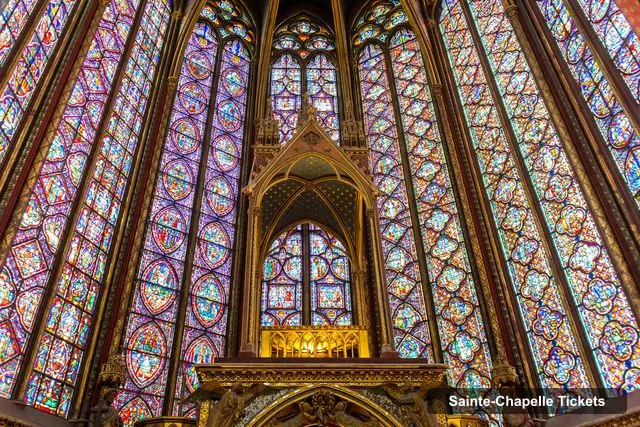
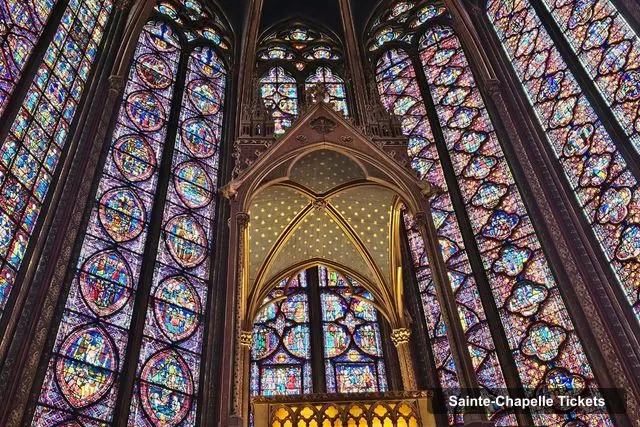
The glass is why people come. Wikipedia counts fifteen great stained-glass windows in the nave and apse of the upper chapel, dating from the mid-13th century, with most put in place between 1242 and 1248. The walls are made of about 670 square metres of glass, not counting the rose window. The three windows of the apse illustrate the New Testament, and the windows of the nave follow Old Testament figures of kingship, from Genesis to the Book of Kings. The glass changes in intensity from hour to hour, mostly in deep blues and reds.
The rose window on the west is later. It was made in the late 15th century in the flamboyant Gothic style, is nine metres in diameter and is composed of eighty-nine separate panels, per Wikipedia.
Sainte-Chapelle History Through Fire, Flood and Revolution
The chapel survived palace fires in 1630 and 1776, but not without damage, especially to the furniture and the roof. The timber-and-lead spire was destroyed and replaced several times. A flood in the winter of 1689 to 1690 damaged the painted walls of the lower chapel, so the ground floor was raised and the original glass removed.
The Revolution was worse. As a symbol of both religion and royalty it was a prime target: it became a grain store, the sculpture and emblems outside were smashed, the spire was pulled down and the relics were dispersed. Reliquaries, including the great chest, were melted for their metal. Despite this, nearly two-thirds of the original stained glass survived. Between 1803 and 1837 the upper chapel held the archives of the Palace of Justice, and the lowest two metres of glass was removed to let the clerks work in more light.
Sainte-Chapelle History Since 1840: Restoration
From 1840, under King Louis-Philippe, a long restoration was led first by Felix Duban and then by Jean-Baptiste Lassus and Emile Boeswillwald, with the young Eugene Viollet-le-Duc as an assistant. It lasted twenty-eight years. The spire you see now, thirty-three metres high and the fifth since the 13th century, is cedar wood by Lassus. Wikipedia says he began it in 1852, while its timeline gives 1853 to 1855, another small disagreement between two parts of the same article.
The latest campaign began in 2008 and cost some 10 million euros, with half from private donors and half from the Villum Foundation. It cleaned the glass and the facade stonework and added a protective thermoformed glass layer outside the windows, and the rose window was completed in 2015, in time for the 800th anniversary of the birth of Saint Louis.
13 Sainte-Chapelle History Facts With Sources
Louis IX bought the relics from Baldwin II for 135,000 livres (Wikipedia).
The chapel itself cost 40,000 livres to build and glaze (Wikipedia).
It was built between 1238 and 1248 and consecrated on 26 April 1248 (Wikipedia).
It measures 36 m long, 17 m wide and 42.5 m high (Wikipedia).
The upper chapel has fifteen great stained-glass windows (Wikipedia).
Its walls hold about 670 square metres of glass, not counting the rose window (Wikipedia).
The rose window is nine metres across and has eighty-nine panels (Wikipedia).
Nearly two-thirds of the original glass survived the Revolution (Wikipedia).
Eighteen original panels are in the Musee de Cluny (Wikipedia).
The current spire is 33 m high and is the fifth since the 13th century (Wikipedia).
The 2008 restoration cost some 10 million euros (Wikipedia).
The chapel was classified as a historical monument in 1862 (Wikipedia).
UNESCO names the Sainte Chapelle among the masterpieces of Paris, Banks of the Seine (UNESCO).
See the Sainte-Chapelle History in Person
A guide helps most with the Sainte-Chapelle history, because the glass tells stories you would otherwise read past. The tour I would pick is the Walks In Europe guided tour at $84, which combines the Sainte-Chapelle, the Conciergerie and Notre-Dame and has 4.7 stars from 878 reviews.
Walks In Europe
Sainte-Chapelle, Conciergerie, Notre Dame Guided Tour
★4.7 (878 reviews)
2 hours
Free cancellation
My pick: My pick for the history: Sainte-Chapelle, Conciergerie and Notre-Dame with a guide, 4.7 from 878 reviews.
What you get, where you meet, what reviewers say
Included
✓ Guided visit to Île de la Cité
✓ Exterior visit to Notre Dame Cathedral
✓ Pre-reserved tickets for Sainte-Chapelle and Conciergerie
✓ Professional and local Walks In Europe tour guides
✓ Small groups of up to 8 people
✓ 2-hour walking tour with anecdotes and memorable moments
Not included / not suitable
✕ Transportation to the meeting point
✕ Entrance to Notre Dame Cathedral
Meeting point: Meet outside the café Brasserie Les Deux Palais. Look for your guide with a sign that says 'Walks In Europe.' 3 Bd du Palais, 75004 Paris, France
Languages: English
Duration: 2 hours
Cancellation: Cancel up to 24 hours in advance for a full refund
“Merva(sp.?) was beyond excellent. She spent a lot of time explaining everything clearly and she answered ever ones questions in depth .” – GetYourGuide review
For a cheaper way in, the $57 entry with an outdoor Notre-Dame tour has 4.7 stars from 641 reviews.
THE PERFECT VACATION
Sainte-Chapelle Entry with Notre Dame Outdoor Tour
★4.7 (641 reviews)
1.5 hours
Free cancellation
My pick: The lower-priced pick: entry plus an outdoor Notre-Dame tour at $57, 4.7 from 641 reviews.
What you get, where you meet, what reviewers say
Included
✓ Sainte-Chapelle entry is included
✓ Notre Dame outdoor walking tour
✓ Guide service
Meeting point: Meeting Point: Join us opposite Café Panis, at the corner of the bridge Pont au Double. Our guide will be wearing a red cap with The Perfect Vacation logo. We look forward to welcoming you there!
Nearest Train: RER B Pont au Double, Paris, France
Languages: English
Duration: 1.5 hours
Cancellation: Cancel up to 24 hours in advance for a full refund
“Our guide was very knowledgeable and helpful. We truly enjoyed our time with her. St Chapelle was incredible! 👍😊” – GetYourGuide review
Wikipedia says it was built between 1238 and 1248, and consecrated on 26 April 1248. A timeline on the same page places the start of construction in 1242 to 1244, so the start date depends on the source. Wikidata gives 1245 as the opening year, which I cannot reconcile with the 1248 consecration.
Why was the Sainte-Chapelle built?+
King Louis IX commissioned it to house his collection of relics of the Passion, including the Crown of Thorns, per Wikipedia. He bought the relics from Baldwin II, the Latin emperor at Constantinople, for 135,000 livres. The chapel itself cost 40,000 livres to build and glaze.
Who designed the Sainte-Chapelle?+
Nobody knows for certain. Wikidata names Pierre de Montreuil, which was the 19th-century assumption, but Wikipedia says no designer is named in the archives and that modern scholarship rejects the attribution in favour of Jean de Chelles or Thomas de Cormont.
Is the stained glass in the Sainte-Chapelle original?+
Much of it, but not all. Wikipedia says nearly two-thirds of the original glass survived the Revolution, and a restoration from 1846 to 1855 replaced about one third with medieval glass from other sources or new glass in the Gothic style. Eighteen original panels are now in the Musee de Cluny.
What happened to the Crown of Thorns?+
The relics were dispersed during the French Revolution, but the Crown of Thorns and some others survived. Wikipedia says they are now kept in the treasury of Notre-Dame de Paris, to which they were transferred in 1805 according to its timeline.
Is the Sainte-Chapelle a UNESCO World Heritage Site?+
It sits inside one. UNESCO's listing Paris, Banks of the Seine names the Cathedral of Notre-Dame and the Sainte Chapelle among the architectural masterpieces along the river. UNESCO does not list the chapel as a separate property.