British Museum history is a story about collecting, and about a building that kept having to grow to hold what the nation acquired. This page gives you a dated timeline, the history period by period, and a numbered list of British Museum facts with the source for each. I used Wikipedia and Wikidata, plus the museum’s own site, and I quote numbers exactly as they are given; where two sections of the same article disagree, I say so. Entry is free, so if you only need the practical side, my page on British Museum tickets explains the free slot and the tours that add a guide.
British Museum History Timeline
Year
What happened
1753
British Museum Act receives royal assent on 7 June; Sloane’s collection is bequeathed to the nation
1759
The museum opens to the public at Montagu House on 15 January
1802
George III presents the Rosetta Stone
1806
Lord Elgin removes Parthenon marbles from Athens
1823
Work on Robert Smirke’s quadrangular building starts
1847
The Front Hall and Great Staircase open
1852
The forecourt opens, completing Smirke’s plan
1857
The Round Reading Room opens
1881
The Natural History Museum is established as the first branch institution
1923
The museum welcomes over one million visitors
1940
The Duveen Gallery is bombed
1953
The museum celebrates its bicentenary
1972
The British Library Act separates the library
2000
The Queen Elizabeth II Great Court opens in December
2025
6,440,120 visitors
British Museum History: Sloane and the Founding
The British Museum started with a bequest. When the physician Sir Hans Sloane died, he left his collection to the nation, and Wikipedia says Parliament paid his heirs 20,000 pounds for it. The collection was about 71,000 objects, including roughly 40,000 printed books and 7,000 manuscripts. The British Museum Act 1753 received royal assent on 7 June, and in 1757 the Old Royal Library joined the Cotton and Harleian libraries as the foundation collections.
The museum bought Montagu House from the Montagu family for 20,000 pounds, and its galleries and reading room opened to the public on 15 January 1759. Wikidata agrees on 1759 as the opening year. That makes the British Museum the world’s first public national museum, per Wikipedia.
British Museum History: Antiquities and Empire
Antiquities came next. The first significant purchase was Sir William Hamilton’s Greek vases in 1772, bought for 8,410 pounds. In 1802 King George III presented the Rosetta Stone, and Lord Elgin removed the Parthenon marbles from Athens in 1806; they were acquired under the British Museum Act 1816. In 1825 Assyrian and Babylonian antiquities were purchased from Mary Mackintosh Rich, and in 1840 Charles Fellows led the first overseas excavation, to Xanthos.
These acquisitions are also the source of debate. Wikipedia covers the disputes over some objects in detail, and I do not try to settle them here; for a visitor the practical point is that these objects are still on show, and my British Museum map page explains where to find the galleries that hold them. Wikipedia also puts the Egypt collection at over 110,000 objects, so no one sees all of it in a single visit.
British Museum History in Stone: Smirke’s Building
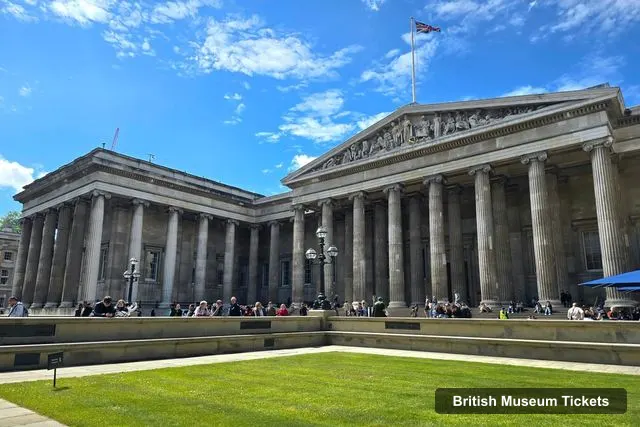
The museum outgrew Montagu House within decades. A buildings committee was set up in 1802, and Wikipedia says work on Robert Smirke’s quadrangular building began in 1823, with the East Wing, which housed the King’s Library of 65,000 volumes and 19,000 pamphlets, finished by 1831. The Front Hall and Great Staircase opened in 1847 and the forecourt in 1852, completing the 1823 plan. The Wikipedia article gives both 1822 and 1823 for the King’s Library gift.
Inside that quadrangle, Sydney Smirke built the Round Reading Room, 140 feet (43 m) in diameter, which opened in 1857. Charles Newton discovered the Mausoleum at Halicarnassus the same year, per the same source. This stage of British Museum history also split the collections: the Natural History Museum was established as the first branch institution in 1881 and the natural history collections moved to South Kensington in 1887.
British Museum History in the 20th Century and Wartime
Visitor numbers grew with the museum: it welcomed over one million visitors in 1923. In the Second World War, evacuation of valuables began on 24 August 1939, and the Duveen Gallery was bombed in 1940. It reopened in 1962 and the Parthenon sculptures returned to it. The museum celebrated its bicentenary in 1953.
In 1972 the British Library Act separated the library from the museum, and the Tutankhamun exhibition drew 1,694,117 visitors that year. The library’s Reading Room closed in 1997, and Wikipedia gives both 1997 and 1998 for the library’s move to St Pancras.
British Museum History: The Great Court and Today
The British Museum history of the last quarter century is mostly about space and access. The museum is run by trustees, 25 in total according to Wikipedia. Fifteen of them are appointed by the Prime Minister, one by the Crown, four by industry bodies and five by other trustees.
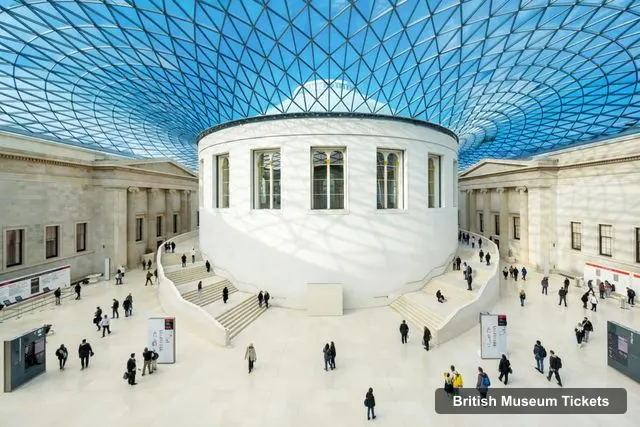
The biggest change of recent history is the Queen Elizabeth II Great Court, which opened in December 2000. Wikipedia says it was designed by Foster and Partners and Buro Happold, with 1,656 glass panes, and that it is the largest covered square in Europe. It turned the old library courtyard into the museum’s main concourse.
The museum has 94 galleries. Wikipedia gives its size as 807,000 square feet (75,000 square metres) in the infobox and over 92,000 square metres in the text, another example of two figures in one article. Its permanent collection is about 8 million objects, the largest in the world, with less than 1 percent on display. In 2025 it received 6,440,120 visitors and was the second most visited attraction in the United Kingdom. The 2023 Wikidata figure is 5,821,000. Hours and entry rules change, so check my British Museum opening hours guide and the museum’s website before you go.
14 British Museum Facts With Sources
The British Museum Act 1753 received royal assent on 7 June 1753 (Wikipedia).
Sloane’s collection was about 71,000 objects, bought for 20,000 pounds (Wikipedia).
It opened to the public at Montagu House on 15 January 1759; Wikidata also lists 1759 (Wikidata).
It was the world’s first public national museum (Wikipedia).
George III presented the Rosetta Stone in 1802 (Wikipedia).
The King’s Library donation was 65,000 volumes and 19,000 pamphlets (Wikipedia).
Robert Smirke is the architect of the main building, begun in 1823 (Wikidata).
The Round Reading Room is 140 feet (43 m) across and opened in 1857 (Wikipedia).
The museum had over one million visitors in 1923 (Wikipedia).
The Tutankhamun exhibition of 1972 drew 1,694,117 visitors (Wikipedia).
The Great Court opened in December 2000 with 1,656 glass panes (Wikipedia).
Less than 1 percent of the collection, about 50,000 items, is on display (Wikipedia).
It received 6,440,120 visitors in 2025 (Wikipedia).
See the British Museum History in the Galleries
A guide ties the British Museum history together better than labels do. My pick is the 2-hour guided tour with priority entrance at $39: rated 4.9 from 1,715 reviews, it is the most reviewed tour I compared and includes the entry ticket and the option of headsets.
BEST TOURS LONDON LTD
2h British Museum Guided Tour with Priority Entrance
★4.9 (1,715 reviews)
2 hours
Free cancellation
My pick: The most-reviewed guided tour: $39, 4.9 from 1,715 reviews, 2 hours, priority entrance included.
What you get, where you meet, what reviewers say
Included
✓ Guided tour of the British Museum with commentary in English/Italian
✓ Entrance tickets to the British Museum for the main entrance with priority timeslots
✓ Option for headsets are available
Not included / not suitable
✕ Transportation
✕ Food and drinks
✕ Tips
Meeting point: The MEETING POINT is inside of the museum, on the right side of the information desk, next to the column. Your guide will be there 5-10 minutes before the tour starts and will have a YELLOW FLAG.
https://goo.gl/maps/93hhDrcHH7An1ftf9 52 Great Russell St, London WC1B 3BA, UK
Languages: French, Italian, English, Greek, Chinese
Duration: 2 hours
Cancellation: Cancel up to 24 hours in advance for a full refund
“we had a good time with Daniel.He helped us to focus on the most essential part in the museum as we have only limited time.Will recommends to those who have limited time.” – GetYourGuide review
If you want a similar tour with a smaller review base, the guided tour with priority entry is $33, rated 4.8 from 157 reviews.
My tour London
British Museum Guided Tour with Priority Entry
★4.8 (157 reviews)
2 hours
Free cancellation
My pick: A cheaper two-hour alternative: $33, 4.8 from 157 reviews, entry ticket included.
What you get, where you meet, what reviewers say
Included
✓ British Museum guided tour
✓ Entry ticket
Meeting point: Meet your guide in front of the British Museum portals on the stairs near the pillars after passing the security check (NOT outside of the gates). The tickets will be provided 1h before the tour via WhatsApp. If you don't have WhatsApp, please contact us via email where we can send the entry tickets. 51 Great Russell St, London WC1B 3BA, UK
Languages: English, French, Italian, Spanish
Duration: 2 hours
Cancellation: Cancel up to 24 hours in advance for a full refund
“We loved our guide Elizabetta, very friendly, enthusiastic and engaging as well as very knowledgable. Highly reccomend.Fantastic day out & hopefully will meet again sometime.” – GetYourGuide review
The British Museum Act 1753 received royal assent on 7 June 1753, per Wikipedia, which says it was established that year as the world's first public national museum. It opened to the public at Montagu House on 15 January 1759, and Wikidata lists 1759 as the opening year.
Who founded the British Museum?+
Its core was the collection of the physician Sir Hans Sloane, bequeathed to the nation in 1753 for 20,000 pounds paid to his heirs. Wikipedia describes about 71,000 objects, including roughly 40,000 printed books and 7,000 manuscripts.
When was the Rosetta Stone given to the British Museum?+
Wikipedia says King George III presented the Rosetta Stone in 1802. It notes that the Egypt section of the same article gives 1803 for the Egyptian antiquities, so the sources differ slightly.
How big is the British Museum collection?+
Wikipedia gives about 8 million objects in its infobox and says the permanent collection of eight million artefacts is the largest in the world. Elsewhere the article mentions over 13 million, and says less than 1 percent, about 50,000 items, is on display.
Is the British Museum free?+
Admission is free except for loan exhibitions, according to Wikipedia. Book the free timed slot on the museum's own site, and see my page on tickets for the British Museum for the guided tours that add a guide or priority entry.