Pantheon Rome history stretches across three buildings, two fires, one emperor who rebuilt it and a pope who turned it into a church, and every date below comes with its source. I took them from Wikipedia and read the figures as the article gives them, because the dome measurements are quoted so widely that they are easy to get wrong. The timeline comes first, then the story by period, then 14 facts. To visit, my page on Pantheon Rome tickets compares all 10 options, from an $8 entry to guided tours.
Pantheon Rome History Timeline
Year
What happened
About 29 to 19 BC
Agrippa’s complex in the Campus Martius, including the first Pantheon, is built
80 AD
A fire destroys the first building; Domitian rebuilds it
110 AD
The Pantheon burns again
117 to 138
Hadrian reconstructs the building
About 126
The present building is probably dedicated
202
Septimius Severus and Caracalla repair it
609
Emperor Phocas gives it to Pope Boniface IV, who consecrates it as a church on 13 May
663
Constans II strips the bronze roof tiles in July
731 to 741
Pope Gregory III lines the rotunda roof with lead
1270
A belfry is built on the portico gable
1527
Relics are looted or destroyed in the Sack of Rome
1623 to 1644
Urban VIII removes the bronze trusses above the portico
1883
The twin bell towers are removed
1885
Work begins on Victor Emmanuel II’s tomb
1998
The doors are restored to full function
2004 to 2005
Restoration addresses water staining and plaster
Pantheon Rome History: Agrippa’s Temple
The first Pantheon was part of a complex that Agrippa built on his own property in the Campus Martius around 29 to 19 BC, according to Wikipedia. That building did not last. A fire in 80 AD destroyed it and Domitian rebuilt it, but it burned again in 110 AD. The Pantheon Rome history that visitors usually quote, the dome and the oculus, belongs to the next building, not the first.
Pantheon Rome History Under Hadrian
Hadrian reconstructed the building between 117 and 138, and Wikipedia says the present structure was probably dedicated around 126. The article also notes that one scholar, Lise Hetland, argues that construction of the present building began under Trajan in 114. I would treat the exact start date as debated and the Hadrianic date as the usual one.
What Hadrian’s builders achieved is easy to list, and the figures matter. The rotunda has a drum wall 6.4 metres thick, carried by eight piers. Wikipedia gives the interior diameter of the dome and the height to the oculus as both about 43 metres, with 43.3 metres in its detailed section. The ring forming the oculus is 9.1 metres across. The dome is 6.4 metres thick at the base and 1.2 metres thick around the oculus, and it weighs about 4,535 tonnes. Its coffers are laid out in five rings of 28.
The portico has granite columns 11.9 metres tall and 1.5 metres in diameter, each weighing about 60 tonnes, and eight of them stand in the front rank. The bronze doors are 4.45 metres wide and 7.53 metres high. Even the floor was planned: it slopes about 30 centimetres for drainage, which explains why rain from the oculus does not pool. The portico floor originally rose seven steps, 1.30 metres, above the forecourt, which is part of why the building feels so low at street level today. Wikipedia also gives the strength of the concrete: a compressive strength of about 20 MPa and an estimated tensile strength of 1.47 MPa. Those numbers are why engineers still study how the dome stays in one piece. For a view of how these parts fit together, see my Pantheon Rome map page, which also covers what to look at inside.
I would add one practical note from this part of the Pantheon Rome history. The measurements above are the ones the article gives, and other books round them differently, so if you quote the dome, quote it as about 43 metres and say where you read it.
Pantheon Rome History: From Temple to Church
In 202 Septimius Severus and Caracalla repaired the building. The decisive moment came on 13 May 609, when Wikipedia says Emperor Phocas gave it to Pope Boniface IV, who consecrated it as a church to St. Mary and the Martyrs. That gift is the main reason the Pantheon survives in such good condition. Wikipedia also reports that twenty-eight cartloads of relics were reportedly moved from the catacombs when it was converted.
The building paid a price. In July 663 Constans II stripped the bronze roof tiles and sent them to Constantinople, and between 731 and 741 Pope Gregory III lined the rotunda roof with lead. Urban VIII removed the bronze trusses above the portico between 1623 and 1644.
Pantheon Rome History in the Middle Ages and Renaissance
A belfry was built on the portico gable in 1270, and relics were looted or destroyed in the Sack of Rome in 1527. In April 1536 Charles V visited during a triumphal procession. Clement XI commissioned the present high altar between 1700 and 1721, and on 23 July 1725 the Pantheon became a cardinal deaconry. In 1753 poor conditions inside prompted a restoration of the dome.
Pantheon Rome History Since Italian Unification
The twin bell towers were removed in 1883, and in 1885 work began on the tomb of Victor Emmanuel II. A Fascist-era restoration of the dome and floor started in 1928, and part of the original attic design was restored in the 1930s. The Italian monarchy was abolished in June 1946. Wikipedia lists a restoration of the doors in 1998, and one in 2004 to 2005 that dealt with water staining and plaster. It also records that the Basilica of Neptune opened to visitors on 25 November 2025.
14 Pantheon Rome Facts With Sources
The first Pantheon was part of Agrippa’s complex in the Campus Martius, about 29 to 19 BC (Wikipedia).
Fires destroyed earlier buildings in 80 AD and again in 110 AD (Wikipedia).
Hadrian reconstructed the building between 117 and 138 (Wikipedia).
The building is 84 metres long, 58 metres wide and 58 metres high at its maximum (Wikipedia).
The dome’s interior diameter and height to the oculus are both about 43 metres (Wikipedia).
The oculus ring is 9.1 metres in diameter (Wikipedia).
Brunelleschi’s dome in Florence, completed in 1436, measures 42 metres, a metre less than the Pantheon’s (Wikipedia).
I found no usable Wikidata entry for the Pantheon in my data, so no Wikidata figure is used on this page. The visitor count is not given in the Wikipedia text I read, so I do not quote one.
See Pantheon Rome History on a Guided Visit
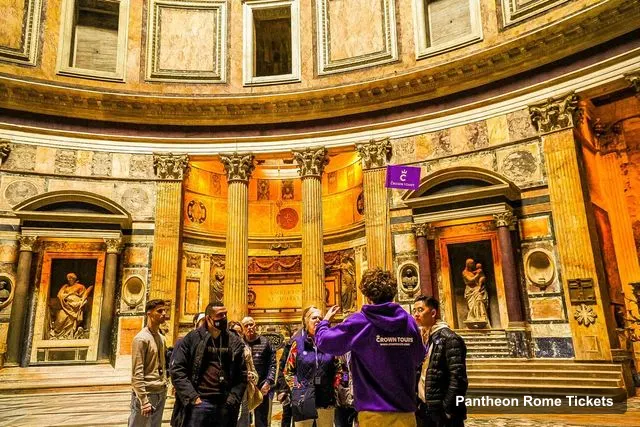
The building is small, and the Pantheon Rome history above is dense, so a live guide adds a lot in 45 minutes. The one I would book for most visitors is Crown Tours: $21, 4.8 stars from 5,685 reviews, 45 minutes, with free cancellation up to 24 hours before.
Crown Tours
Pantheon Timeless Marvel Guided Tour with Entry Ticket
★4.8 (5,685 reviews)
45 minutes
Free cancellation
My pick: The best-reviewed guided tour: $21, 4.8 from 5,685 reviews, entry included, free cancellation up to 24 hours before.
What you get, where you meet, what reviewers say
Included
✓ Live guide
✓ Guided tour
✓ Pantheon entry tickets
✓ Hosted assistance
Not included / not suitable
✕ Transportation
✕ Food and drinks
✕ Tips
Meeting point: This activity has 3 meeting points. Your meeting point depends on the option you select. Piazza della Minerva, 00186 Roma RM, Italy
If you want the smallest group, the Kirba Tours small-group option is $29 with a 4.9 rating from 1,378 reviews.
Kirba Tours
Pantheon Small-Group Guided Tour with Entry Ticket
★4.9 (1,378 reviews)
50 minutes
Free cancellation
My pick: The small-group pick: $29, 4.9 from 1,378 reviews, 50 minutes with entry included.
What you get, where you meet, what reviewers say
Included
✓ Pantheon entry ticket
✓ Pantheon tour
✓ Official guide
✓ Headset to hear the guide clearly (for groups of 6 people or more)
Not included / not suitable
✕ Hotel pickup and drop-off
✕ Tips
Meeting point: Meet your guide in Piazza Capranica, 10 minutes prior to the start time of the tour. Look for the Kirba Tours sign or flag. Piazza Capranica, 00186 Roma RM, Italy
Languages: English, Italian
Duration: 50 minutes
Cancellation: Cancel up to 24 hours in advance for a full refund
“Chris was a fantastic tour guide. Great tour! Would highly receommend.” – GetYourGuide review
Wikipedia says the original temple was built in Agrippa's complex on the Campus Martius, and that fires in 80 AD and 110 AD destroyed earlier versions. The present building was reconstructed under Hadrian, who ruled from 117 to 138, and was probably dedicated around 126. One scholar cited there argues that construction began under Trajan in 114.
Who built the Pantheon?+
Agrippa built the first temple, and Wikipedia credits Hadrian with the reconstruction that you see today. Domitian rebuilt it after the fire of 80 AD. Septimius Severus and Caracalla repaired it in 202.
Why is the Pantheon still standing?+
It was given to Pope Boniface IV by Emperor Phocas on 13 May 609 and consecrated as a church to St. Mary and the Martyrs, per Wikipedia. Continuous use as a church kept it maintained, while many other Roman temples were stripped or abandoned.
How big is the dome of the Pantheon?+
Wikipedia gives the interior diameter and the height to the oculus as about 43 metres (142 ft), and 43.3 m in its detailed section. The oculus ring is 9.1 metres (30 ft) across. Brunelleschi's dome in Florence, finished in 1436, is 42 metres by the same article.
What happened to the Pantheon's bronze?+
Wikipedia records that in July 663 Constans II stripped the bronze roof tiles and sent them to Constantinople. Between 1623 and 1644 Urban VIII removed the bronze trusses above the portico.
Is the Pantheon free to enter?+
Not as a rule. The tickets I compare start at $8 and the Pantheon's own site links a free-entry page for the first Sunday of the month, as I note in my opening-hours guide. Check the official site for the rules on your date.