Sagrada Familia history is one of the longest building stories in Europe, and this page gives it as a timeline, then period by period, then as a numbered list of facts with the source for each. Every line of Sagrada Familia history here comes from Wikipedia, Wikidata or UNESCO, and I give numbers exactly as those sources do. Where they differ I say so. It is the page to read before you go in, and when you are ready to choose entry, my guide to tickets for the Sagrada Familia compares all 10 options.
Sagrada Familia History Timeline
Year
What happened
1872
The bookseller Josep Maria Bocabella returns from the Vatican wanting to build a church inspired by the basilica at Loreto
1882
Construction begins on 19 March under Francisco de Paula del Villar
1883
Villar resigns on 18 March; Antoni Gaudi takes over the design
1893 to 1936
The Nativity facade is built
1926
Gaudi dies, with the basilica between 15 and 25 percent complete
1936
Fire in the crypt and a break-in at the workshop during the Spanish Civil War destroy models and plans
1954
Construction of the Passion facade begins; its steeples are finished in 1976
2000
The vaulting of the central nave is completed
2002
Construction of the Glory facade begins
2005
The Nativity facade and the crypt are added to the UNESCO World Heritage inscription
2010
Pope Benedict XVI consecrates the church on 7 November and proclaims it a basilica
2025
On 30 October it becomes the world’s tallest church at 162.91 m
2026
The Tower of Jesus Christ reaches 172.5 m on 20 February and is blessed on 10 June
Sagrada Familia History Begins With Bocabella
The Sagrada Familia history starts with a bookseller, not an architect. Wikipedia says the Sagrada Familia was inspired by a bookseller, Josep Maria Bocabella, who founded a devotional association and came back from a visit to the Vatican in 1872 wanting to build a church modelled on the basilica at Loreto. It was to be an expiatory temple paid for entirely by donations from people who wanted to counter a growing rejection of the Catholic Church. The apse crypt was begun on 19 March 1882, to a plan by Villar for a standard Gothic revival church.
Villar left after a year. On 18 March 1883 Gaudi took responsibility for the design and changed it radically. Wikipedia adds a small gap in the dates that is easy to miss: he began work in November 1883 but was not appointed Architect Director until 28 March 1884.
Sagrada Familia History Under Gaudi: 1883 to 1926
In the history of the Sagrada Familia, Gaudi is the central figure: he devoted the rest of his life to the project and is buried in the crypt. Wikipedia quotes his remark about the slow pace: “My client is not in a hurry.” The Nativity facade, built between 1893 and 1936, is the part closest to his own hand, and he chose it as the first because he believed it was the most attractive and accessible, and that a harsher facade built first would have driven people away.
How much he finished is where the history differs by source. The introduction to the Wikipedia article says less than a quarter of the project was complete when he died in 1926, while the history section gives between 15 and 25 percent. I would not quote a single figure, only that it was a minority of the building.
Sagrada Familia History Through War and Fire: 1936 to 2000
In July 1936, anarchists set fire to the crypt and broke into the workshop, partly destroying Gaudi’s original plans, per Wikipedia. In 1939 Francesc de Paula Quintana took over site management, and work continued with the material that was saved and with plans reconstructed from published drawings and photographs. Construction resumed with intermittent progress in the 1950s.
The Passion facade followed Gaudi’s 1917 design. Construction began in 1954 and its steeples were finished in 1976, and in 1987 a team of sculptors headed by Josep Maria Subirachs began the stone scenes. Wikipedia describes the result as austere, carved with harsh straight lines to resemble the bones of a skeleton. Computers entered the design office in the 1980s, and the central nave vaulting was completed in 2000.
The 21st Century in Sagrada Familia History
The recent history of the Sagrada Familia moved faster than the first century of it. The Glory facade, the main entrance and the largest of the three, was started in 2002, and its central doors by Subirachs were installed in September 2008. The church was consecrated by Pope Benedict XVI on 7 November 2010 in front of a congregation of 6,500, with another 50,000 following the Mass from outside.
On 30 October 2025 a section of the central tower reached 162.91 m, passing Ulm Minster at 161.53 m. The tower topped out at 172.5 m on 20 February 2026, and Pope Leo XIV blessed it on 10 June 2026, the centenary year of Gaudi’s death. Wikipedia says Gaudi’s original design calls for eighteen spires, and fourteen have been completed as of 2026. Stone from Montjuic, used at first, became fragile as the quarry deepened, so since 2018 the needed stone has come from the Withnell Quarry near Chorley in England.
Inside the Sagrada Familia: Design Facts
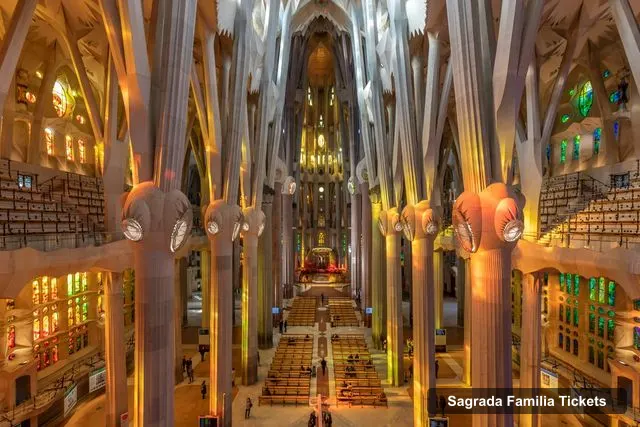
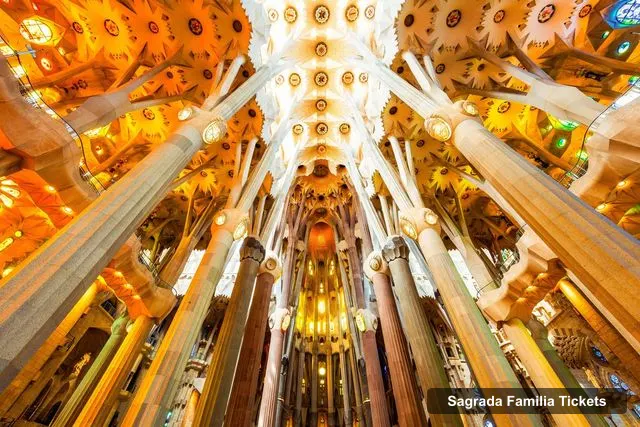
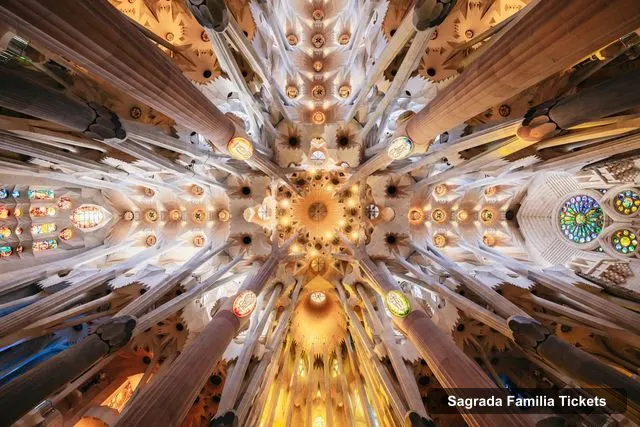
The plan is a Latin cross with five aisles. Wikipedia gives the central nave vaults at forty-five metres and the side nave vaults at thirty, with the central vault at sixty metres and the apse vault at seventy-five, so the ceiling rises as you walk toward the altar. It adds that there are no exact right angles to be seen inside or outside the church. The columns branch like trees, and their cross-section changes as they rise, from a square base to an octagon, then a sixteen-sided form and finally a circle.
The organ installed in 2010 has 26 stops and 1,492 pipes. If you want a route through these spaces rather than a list, my Sagrada Familia map page walks through what to see inside.
UNESCO Status in Sagrada Familia History, and Visitor Numbers
Not all of the basilica is a World Heritage Site. UNESCO describes seven properties by Antoni Gaudi (1852 to 1926), inscribed in 1984 and 2005, and Wikipedia notes that the 2005 extension covers the Nativity facade and the crypt of the Sagrada Familia, not the whole church. Wikidata records 4,830,000 visitors in 2024, while Wikipedia, in its prose, estimates 5 million in 2025. Those are different years and different kinds of source, so treat them as the scale of the crowd, not as a comparison.
14 Sagrada Familia Facts With Sources
Construction began on 19 March 1882 (Wikipedia; Wikidata gives 1882 as the start year).
Gaudi took over the design in 1883 and is buried in the crypt (Wikipedia).
The central Tower of Jesus Christ is 172.5 m high (Wikidata).
It is the tallest church in the world, 11 metres taller than Ulm Minster (Wikipedia).
Gaudi’s design calls for eighteen spires, and fourteen are complete as of 2026 (Wikipedia).
Gaudi died in 1926 with the basilica between 15 and 25 percent finished, though the article’s introduction says less than a quarter (Wikipedia).
A fire in July 1936 partly destroyed Gaudi’s plans (Wikipedia).
The Nativity facade was built between 1893 and 1936 (Wikipedia).
The Passion facade steeples were finished in 1976 (Wikipedia).
The central nave vaults reach 45 metres and the apse vault 75 metres (Wikipedia).
Pope Benedict XVI consecrated the church on 7 November 2010 (Wikipedia).
The 2010 organ has 26 stops and 1,492 pipes (Wikipedia).
UNESCO inscribed the Works of Antoni Gaudi in 1984 and extended it in 2005 (UNESCO).
The basilica had 4,830,000 visitors in 2024 (Wikidata).
See the Sagrada Familia History on a Guided Tour
A guide is the quickest way to connect the Sagrada Familia history to what you see. The one I would pick is the Crown Tours priority-access tour at $60, which has 4.8 stars from 6,433 reviews, a live guide, skip-the-line entry and free cancellation up to 24 hours before.
Crown Tours
Sagrada Familia Priority Access Guided Tour
★4.8 (6,433 reviews)
1.5 hours
Free cancellation
My pick: My pick for the history: a live guide, priority entry and free cancellation, 4.8 from 6,433 reviews.
What you get, where you meet, what reviewers say
Included
✓ Guide
✓ Entry ticket to Sagrada Família
✓ Skip-the-Line Entry
✓ Comfortable audio system to hear the tour guide better
Not included / not suitable
✕ Transportation
✕ Food and drinks
✕ Tips
Meeting point: Address Details:
Plaça de Gaudí, 08013 Barcelona
Google Maps Link:
https://maps.app.goo.gl/WqAn4ecasrRyXmUz5
Directions:
Meet us at Plaça de Gaudí near the children's playground, a few minutes walk from the Mallorca - Marina Station.
Tour Coordinators:
Your host will be easy to recognize wearing a purple Crown Tours jacket near the stairs.
Arrival:
Please arrive at the meeting point 30 minutes before the activity start time.
Kindly note that Late arrivals are not guaranteed participation to the activity. Spagna, Barcelona, L'Eixample, Carrer Gaudí 417
Languages: English
Duration: 1.5 hours
Cancellation: Cancel up to 24 hours in advance for a full refund
“Our guide Lena gave us incredibly detailed and informed tour. We had a most wonderful time. 10/10!!” – GetYourGuide review
If you would rather have the most-reviewed guided option, the skip-the-line entry ticket and tour at $66 has 4.8 stars from 15,458 reviews.
4 YOU BARCELONA, S.L.
Sagrada Familia Skip-the-Line Entry Ticket & Tour
★4.8 (15,458 reviews)
1.5 hours
Free cancellation
My pick: The most-reviewed guided option: 4.8 from 15,458 reviews, entry included.
What you get, where you meet, what reviewers say
Included
✓ Entrance fees and tickets
✓ Official tour guide
✓ Personal audio reinforcement (if more than 10 people)
Not included / not suitable
✕ Access to the towers
✕ Hotel pickup and drop-off
Meeting point: Meet your guide between the Hard Rock and KFC, in front of the modernist lamppost.
To find us, look for the guide with a red flag
Av. de Gaudí, 1, Eixample
08025 Barcelona
https://maps.app.goo.gl/WoN6TX1ypXCWUWe8A Av. de Gaudí, 1, Eixample, 08025 Barcelona, Espanya
Languages: French, Italian, English, Spanish, German
Duration: 1.5 hours
Cancellation: Cancel up to 24 hours in advance for a full refund
“Monserrat was so knowledgeable and gave us a fantastic insight into this incredible work of art. Would highly recommend.” – GetYourGuide review
Construction began on 19 March 1882, the feast of St. Joseph, with the apse crypt, to a design by the architect Francisco de Paula del Villar, per Wikipedia. Wikidata also gives 1882. Villar resigned on 18 March 1883 and Antoni Gaudi took over the design.
Is the Sagrada Familia finished?+
The tallest tower is. Wikipedia says the central Tower of Jesus Christ reached its full height of 172.5 m on 20 February 2026 and was blessed on 10 June 2026. The Glory facade is still incomplete, and Wikipedia says the interior of the tower is expected to be finished in 2028, so the basilica is still a building site.
How tall is the Sagrada Familia?+
172.5 m (566 ft) at the top of the central tower, per Wikipedia and Wikidata. That makes it the tallest church in the world, 11 metres taller than the former record holder, Ulm Minster at 161.5 m. Wikipedia says Gaudi planned the tower to be one metre shorter than Montjuic hill.
Who designed the Sagrada Familia?+
Francisco de Paula del Villar drew the first Gothic revival plan, but Antoni Gaudi redesigned it from 1883 and worked on it for the rest of his life. He died in 1926 and is buried in the crypt. Later architects including Jordi Fauli, who took over in 2012, have continued his plans.
Is the Sagrada Familia a UNESCO World Heritage Site?+
Partly. UNESCO lists the Works of Antoni Gaudi, inscribed in 1984 and extended in 2005. Of the seven properties, only the Nativity facade and the crypt of the Sagrada Familia are included, per UNESCO and Wikipedia. The rest of the basilica is outside the inscription.
Why did it take so long to build?+
Wikipedia gives two reasons: construction relied solely on private donations, and the Spanish Civil War interrupted it. In July 1936 a fire in the crypt and a break-in at the workshop partly destroyed Gaudi's plans. Computer-aided design and CNC stone cutting have sped the work since the 1980s.