These Sistine Chapel facts come with dates and a source for each, because most of what circulates about the chapel is a half-remembered story. I wrote this page from Wikipedia, Wikidata and UNESCO and give numbers exactly as they do. Where two of them differ I show both. If you already know you want to go in, my guide to tickets for the Sistine Chapel compares ten ways to book the Vatican Museums visit that ends there.
Sistine Chapel Facts: The Timeline
Year
What happened
1368
The earlier Cappella Maggiore is recorded as existing on the site
1473 to 1481
Pope Sixtus IV has the present chapel built, designed by Baccio Pontelli
1481 to 1482
Perugino, Botticelli, Ghirlandaio, Rosselli and their workshops paint the wall cycles of Moses and Christ
1483
The first mass, on 15 August, consecrates the chapel to the Virgin Mary
1492
The first papal conclave in the chapel, from 6 to 11 August, elects Alexander VI
1508 to 1512
Michelangelo paints the ceiling for Pope Julius II
1515
Raphael is commissioned to design ten tapestries for the lower walls
1527
The tapestries are looted in the Sack of Rome
1535 to 1541
Michelangelo paints The Last Judgment over the altar
1984
The ceiling restoration begins on 7 November; UNESCO inscribes Vatican City
1994
The chapel reopens on 8 April after the restoration
Sistine Chapel Facts Before Michelangelo
The present chapel replaced an older one. Wikipedia says the Cappella Maggiore, recorded in 1368, was in a ruinous state with its walls leaning by the time it was demolished, and that the proportions of the new building appear to follow the old. Sixtus IV, whose name it carries, had it built between 1473 and 1481 on the same site, to the plans of Baccio Pontelli and under the supervision of Giovannino de Dolci. The first mass, on 15 August 1483, was for the Feast of the Assumption.
Among the Sistine Chapel facts that surprise people, its use has hardly changed. Wikipedia says the chapel is mainly the chapel of the Papal Chapel, the body that gathers for the services of the papal calendar, and that it keeps a permanent choir. The best-known piece written for that choir is Gregorio Allegri’s Miserere.
Sistine Chapel Facts About the Building
The room is plain on the outside, and the first of the Sistine Chapel facts about it is how modest it looks. Wikipedia describes about 35 metres in length, 14 m in width and a ceiling about 20 m above the floor, while Wikidata gives 21 m for the height. It adds that the proportions use the length as the unit of measurement: the width is a third of it and the height a half. There is no exterior facade or processional doorway, because entry has always been from rooms inside the Apostolic Palace.
Inside, the floor is in opus alexandrinum, in marble and coloured stone, and a marble screen divides the chapel in two. The ceiling was first painted blue and dotted with gold stars, a design Wikipedia credits to Piermatteo Lauro de’ Manfredi da Amelia, and Michelangelo’s work replaced it entirely.
Sistine Chapel Facts From the Walls, 1481 to 1482
The oldest paintings are on the side walls. Wikipedia says the central tier holds two cycles, the Life of Moses on the south wall and the Life of Christ on the north, commissioned in 1480 by Sixtus IV and carried out by Ghirlandaio, Botticelli, Perugino, Rosselli and their workshops. Each cycle has six scenes. Below them are painted hangings in silver and gold, and above them a gallery of popes.
In 1515 Pope Leo X commissioned Raphael to design a series of ten tapestries for the lower walls, which were woven in Brussels over four years. They were looted in 1527 and mostly lost, and a set was reassembled and displayed again in the chapel in 1983.
Sistine Chapel Facts About Michelangelo’s Ceiling
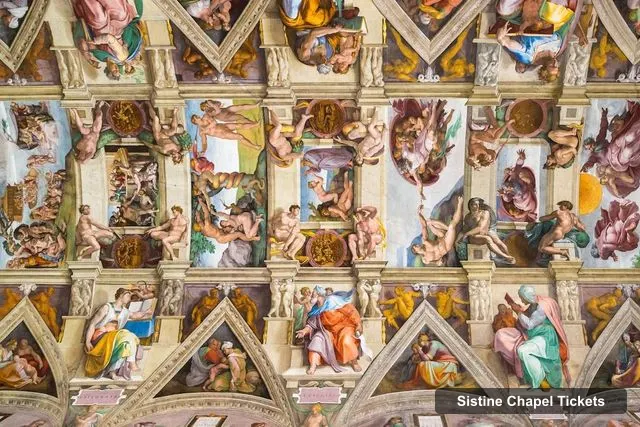
Michelangelo did not want the job. Wikipedia says he saw himself as a sculptor, and that the original commission was to paint the twelve apostles. He asked for a free hand, and the result was nine scenes from Genesis, twelve prophets and sibyls, and the ancestors of Christ, with more than three hundred figures in all.
The painted area is about 40 m long by 13 m wide, which Wikipedia converts to well over 5,000 square feet, or 460 m2. A popular belief is that he lay on his back to paint. Wikipedia says he did not: he built a flat wooden platform on brackets set into the wall and painted standing. It also notes that Bramante’s first scaffold, hung on ropes, would have left holes in the vault, and that Michelangelo rejected it.
The Last Judgment: Sistine Chapel Facts From the Altar Wall
The altar wall came later. Wikipedia says Michelangelo painted The Last Judgment from 1535 to 1541, between the Sack of Rome in 1527 and the Council of Trent in 1545, though another passage on the same page gives 1537 to 1541, so the start date varies within the article. Painting it meant destroying two scenes from the wall cycles, several popes and two sets of ancestors. The nudes caused a dispute, and Daniele da Volterra was later paid to cover the genitals, earning the nickname Il Braghettone, the breeches-painter.
Conclaves and Sistine Chapel Facts Today
One of the chapel’s functions is the election of each new pope. For a conclave, a chimney is installed in the roof, and the smoke is the signal. Wikipedia says white smoke is made by burning the ballots alone, and black smoke by burning them with wet straw, with chemical additives used for both. The first conclave in the chapel was in 1492. Since 1996 the cardinals have been lodged at the Domus Sanctae Marthae but still vote in the Sistine Chapel.
Restoration, 1984 to 1994: Sistine Chapel Facts and Debate
The ceiling restoration began on 7 November 1984, and the chapel reopened on 8 April 1994. The emerging brightness of the Ancestors of Christ caused alarm. Wikipedia describes a critical reading by Arguimbau that the restorers assumed Michelangelo worked only in true fresco, then removed everything else as contamination. It is an argument about method, and the page says so; I would not take a side.
14 Sistine Chapel Facts With Sources
Pope Sixtus IV had the chapel built between 1473 and 1481 (Wikipedia).
The Last Judgment was painted between 1535 and 1541 (Wikipedia).
Raphael’s ten tapestries were commissioned in 1515 and looted in 1527 (Wikipedia).
The ceiling restoration ran from 7 November 1984 to 8 April 1994 (Wikipedia).
A full-size replica showed in Mexico City from 1 June to 15 July 2016, made from 2.6 million photographs (Wikipedia).
UNESCO inscribed Vatican City, including the chapel, in 1984 (UNESCO).
See the Chapel With a Guide
A guide turns these Sistine Chapel facts into a route, and the tour I would choose is the Made in Rome Tours skip-the-line tour at $66. It has 4.6 stars from 11,985 reviews and covers the Vatican Museums, the Sistine Chapel and St. Peter’s Basilica in about 3 hours.
Made in Rome Tours
Vatican, Sistine Chapel & St. Peter's Skip-the-Line Tour
★4.6 (11,985 reviews)
3 hours
Free cancellation
My pick: My pick: Museums, Sistine Chapel and St. Peter's with a guide, 4.6 from 11,985 reviews.
What you get, where you meet, what reviewers say
Included
✓ Guide
✓ Guaranteed skip-the-line access
✓ Access to the Vatican Museums, Sistine Chapel and St. Peter's Basilica
Not included / not suitable
✕ Gratuities (Tips)
Meeting point: The meeting point is located in Borgo Pio, near St. Peter's square. The exact address is Via Plauto 17/A. IMPORTANT: Please check your booking for the start time of the Vatican ENGLISH tour. Arrive 20 minutes before at the meeting point ( Via Plauto 17A ) for check-in. Thank you ! Via Plauto, 17, 00193 Roma RM, Italy
Languages: English
Duration: 3 hours
Cancellation: Cancel up to 24 hours in advance for a full refund
“Thank you Mario! Such a passionate, knowledgeable guide … Tour as described - perfect way of experiencing the Vatican.” – GetYourGuide review
For a specialist, the expert-led Sistine Chapel tour at $82 has 4.7 stars from 1,040 reviews.
City Lights Tours
Vatican Museums: Expert-Led Sistine Chapel Tour
★4.7 (1,040 reviews)
2.5 - 3 hours
Free cancellation
My pick: The best-rated guided option: an expert-led Sistine Chapel tour, 4.7 from 1,040 reviews.
What you get, where you meet, what reviewers say
Included
✓ Skip-the-ticket-line access to the Vatican Museums
✓ Direct access to Sistine Chapel
✓ Direct access to St. Peter's Basilica (if option selected)
✓ Licensed, professional tour guide
✓ Headsets to hear guide clearly
✓ Staff assistance at meeting point
Meeting point: Meet your host at Bar Da Paolo (Viale Vaticano 104). The host will check you in and introduce you to your group. Viale Vaticano, 104, 00165 Roma RM, Italy
Languages: English
Duration: 2.5 - 3 hours
Cancellation: Cancel up to 24 hours in advance for a full refund
“Very expensive and if everyone has skip the line then no one has it 🤷♀️. Guide was brilliant and very knowledgeable and engaging.” – GetYourGuide review
Wikipedia says Pope Sixtus IV had it built between 1473 and 1481, to a design by Baccio Pontelli, and that the first mass was held on 15 August 1483, when it was consecrated and dedicated to the Virgin Mary. Wikidata gives 1473, the year work began, as the opening year.
How long did Michelangelo take to paint the Sistine Chapel ceiling?+
He painted the ceiling between 1508 and 1512 for Pope Julius II, per Wikipedia, which is about four years. He returned later to paint The Last Judgment on the altar wall, between 1535 and 1541. Wikipedia also notes he painted standing, not lying on his back.
How big is the Sistine Chapel?+
Wikipedia gives about 35 metres long and 14 m wide, with the ceiling rising to about 20 m. Wikidata gives a height of 21 m, so the two sources differ by about a metre. The painted ceiling area is about 40 m by 13 m, or over 460 square metres.
What happens in the Sistine Chapel during a conclave?+
The cardinals vote there to elect a pope. A chimney is installed in the roof, and white smoke means a new pope has been elected while black smoke means no candidate has two-thirds. The first conclave held in the chapel was in 1492, per Wikipedia, and it elected Alexander VI.
Was the Sistine Chapel ceiling restored?+
Yes. Wikipedia says the ceiling restoration began on 7 November 1984 and the chapel reopened to the public on 8 April 1994. The cleaning was controversial: some critics feared it removed the artist's own finishing touches, a debate Wikipedia describes at length.
Is the Sistine Chapel part of a UNESCO site?+
Yes, as part of Vatican City, which UNESCO inscribed in 1984. UNESCO's description mentions the Sistine Chapel and its mural decoration, begun by Perugino, Botticelli and other painters and completed in the 16th century by Michelangelo.