Eiffel Tower facts are easier to remember with dates, so this page gives you both: a timeline, the story by period, and a numbered list of 14 facts with the source for each. I wrote it from Wikipedia, Wikidata and the tower’s official site, and I give numbers exactly as those sources give them. If you are ready to go up rather than read, my page on tickets for the Eiffel Tower compares all 10 options.
Eiffel Tower History Timeline
Year
What happened
1884
In May, Maurice Koechlin sketches the first idea
1886
On 1 May the competition terms are changed to require a 300 metre tower
1887
Contract signed on 8 January; foundations begin on 28 January; protest petition published on 14 February
1889
Structure completed on 31 March; exposition opens on 6 May; lifts run from 26 May
1909
Saved from dismantling because of its value for radio telegraphy
1930
The Chrysler Building ends its 41 years as the tallest structure
1940
French saboteurs cut the lift cables as Paris is occupied
1964
Declared a historical monument
1991
Part of a UNESCO World Heritage Site
2002
200,000,000th visitor on 28 November
2022
5,889,000 visitors
Eiffel Tower Facts: From Sketch to Contract
The idea started in May 1884 with a sketch by Maurice Koechlin. Wikipedia names Emile Nouguier as the other lead engineer and says Stephen Sauvestre added the decorative arches and other embellishments. Gustave Eiffel presented the plans on 30 March 1885, and on 1 May 1886 Edouard Lockroy changed the competition terms to require a 300 metre four-sided tower, which effectively made Eiffel’s design the winner, according to Wikipedia.
The contract was signed on 8 January 1887. Eiffel received 1.5 million francs toward construction, less than a quarter of the estimated 6.5 million francs, but he kept the commercial income from the exhibition and the 20 years that followed. Wikidata lists Stephen Sauvestre as the architect.
The Artists’ Protest
On 14 February 1887 a protest petition appeared in Le Temps, opposing the tower on artistic grounds. It did not stop the work. The foundations had already started on 28 January 1887 and were finished on 30 June 1887.
Eiffel Tower Facts About the Build
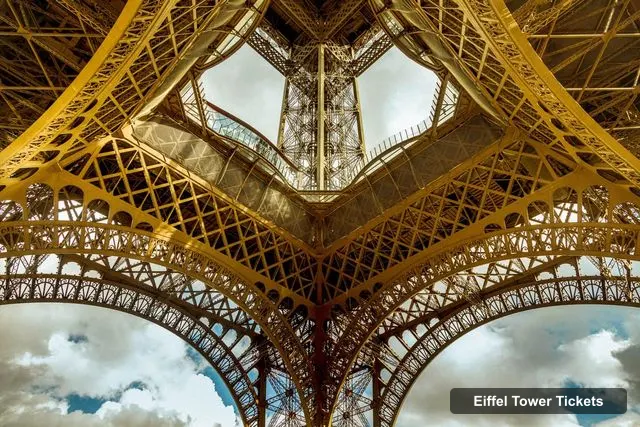
The Eiffel Tower facts that surprise people most are about the scale of the ironwork. Wikipedia counts 18,038 parts, 2.5 million rivets and 7,300 tonnes of puddle iron, with a total weight of about 10,100 tonnes once the lifts, shops and antennae are included. The legs were joined at the first level in March 1888 and the main structural work was completed on 31 March 1889.
Wikipedia also says only one worker died, despite about 300 employees on site. The figure is worth quoting because it is easy to assume a project of this size was far more dangerous.
Opening in 1889
The 1889 exposition opened on 6 May 1889 and the tower opened to the public nine days later. The lifts entered service on 26 May 1889. By the end of the exhibition the tower had nearly 1,896,987 visitors, according to Wikipedia.
Eiffel Tower Facts on Height and Records
The tower has three different heights, and it helps to know which is which. Wikipedia gives 300 metres of architectural height, 330 metres to the tip and 276 metres to the top floor. Wikidata gives 330 metres and 3 floors. The tower was the tallest human-made structure in the world from 1889 until the Chrysler Building was finished in 1930, which is 41 years. A broadcasting aerial added in 1957 made it 11 metres taller than the Chrysler Building.
Eiffel Tower History: Close Calls
The Eiffel Tower history includes two near misses. It was originally slated for dismantling in 1909, and Wikipedia says it was spared because of its value for radio telegraphy. In 1910 it became part of the International Time Service. The article also says its transmitter reportedly disrupted German communications during the First Battle of the Marne in 1914.
The second came in the Second World War. In 1940 French saboteurs cut the lift cables when Paris was occupied, and the lifts were not repaired until 1946. Wikipedia reports that in August 1944 Hitler ordered the tower demolished and General Dietrich von Choltitz disobeyed. The German flag was replaced by a Tricolour on 25 August 1944.
Modern Eiffel Tower Facts: Protection and Visitors
The tower was declared a historical monument in 1964 and in 1991 became part of a UNESCO World Heritage Site. On 28 November 2002 it received its 200,000,000th guest. Wikipedia says it has operated at about 7 million visitors a year since 2003, with 6.91 million in 2015 and 5,889,000 in 2022. Wikidata lists 6,207,303 visitors for 2017.
Upkeep is constant. Wikipedia says about 60 tons of paint are used every 7 years, the tower has been repainted at least 19 times, most recently in 2010, and lead paint stopped being used in 2001. The climb on foot is over 300 steps to the first level and over 300 more to the second, about 600 in total.
Which Eiffel Tower Facts Are Worth Checking
Most of the Eiffel Tower facts repeated online are fine, but a few depend on which source you read. Visitor figures vary by year, so I give each number with its year, and the height depends on whether you count the antennae. Opening dates also differ slightly, because the exposition opened on 6 May 1889, the public could climb nine days later and the lifts started on 26 May. When you plan a visit, treat the Eiffel Tower facts on this page as background and rely on the official site for current prices, closures and floor access.
14 Eiffel Tower Facts With Sources
Foundation work began on 28 January 1887 (Wikipedia).
Wikidata gives 1889 as the opening year (Wikidata).
The tower is 330 metres tall to the tip, with 3 floors (Wikidata).
The architectural height is 300 metres and the top floor is at 276 metres (Wikipedia).
It has 18,038 parts and 2.5 million rivets (Wikipedia).
The iron weighs 7,300 tonnes, and the whole structure about 10,100 tonnes (Wikipedia).
Only one worker died during construction (Wikipedia).
The tower opened to the public nine days after the exposition opened on 6 May 1889 (Wikipedia).
It was the tallest human-made structure for 41 years, until 1930 (Wikipedia).
Gustave Eiffel’s company designed and built it, and Wikidata lists Stephen Sauvestre as architect (Wikidata).
It was spared dismantling in 1909 because of radio telegraphy (Wikipedia).
About 60 tons of paint are used every 7 years (Wikipedia).
The 200,000,000th visitor came on 28 November 2002 (Wikipedia).
The tower had 5,889,000 visitors in 2022 (Wikipedia).
See the Eiffel Tower Facts in Person
A guide turns these Eiffel Tower facts into something you can point at. The most-reviewed guided option in my comparison is the Blue Fox guided tour with summit access at $110, rated 4.4 from 3,902 reviews and lasting 1.5 hours. It is non-refundable, so book it only when your dates are fixed.
Blue Fox Travel
Eiffel Tower Guided Tour with summit access
★4.4 (3,902 reviews)
1.5 hours
My pick: The most-reviewed guided option: $110 with summit access, 4.4 from 3,902 reviews, but non-refundable.
What you get, where you meet, what reviewers say
Included
✓ Guided tour of the Eiffel Tower
✓ Ticket to the 1st and 2nd floor of the Eiffel Tower
✓ Ticket for the summit access
✓ Panoramic views of Paris
✓ Information about Parisian landmarks
Meeting point: Meet the local partner in front of 1 Avenue de Suffren. Please note that you are not looking for an office or booth, but meeting with a person in front of a building. The guide always arrives 5 minutes before the tour start. Please exchange your voucher at the meeting point. Do not go to the Eiffel Tower to collect your ticket. Please arrive on time as late arrivals are considered a no-show and will not be able to access the Eiffel Tower.
Languages: English
Duration: 1.5 hours
Cancellation: This activity is non-refundable
“Loved this tour great value for money. Our guide Dana was great very bubbly & informative. The view from the summit was spectacular with amazing views all round especially when sun was setting. Highly recommend” – GetYourGuide review
For a cheaper guided visit with free cancellation, the Crown Tours summit or second floor guided tour costs $43, with 4.5 stars from 1,505 reviews, and you can cancel up to 24 hours ahead.
Crown Tours
Eiffel Tower Summit or 2nd Floor Guided Tour
★4.5 (1,505 reviews)
1 - 2.5 hours
Free cancellation
My pick: The value pick: $43, 4.5 from 1,505 reviews, free cancellation up to 24 hours ahead.
What you get, where you meet, what reviewers say
Included
✓ Eiffel Tower tour with access to the 2nd floor, or 2nd floor + summit (based on option selected)
✓ Live guide in English
✓ Eiffel Tower elevator access
✓ 1-hour Seine River cruise ticket with flexible timing (if Seine River cruise option is selected)
✓ Multilingual audio guide provided inside the cruise (if Seine River cruise option is selected)
✓ Friendly staff at check-in for smooth coordination
Not included / not suitable
✕ Transportation
✕ Food and drinks
✕ Gratuities
Meeting point: Check in with your Crown Tours host at least 15 minutes before your activity start time. Our meeting point is located in the small park on Allée Léon-Bourgeois, next to the ticket line for Entrance 1. Look for our staff wearing a purple “Crown Tours” T-shirt/ jacket. All. Léon Bourgeois, 75007 Paris, France
Languages: English
Duration: 1 - 2.5 hours
Cancellation: Cancel up to 24 hours in advance for a full refund
“The tour was good and the tour guide Lucielle-Omondi Dupont was very knowledgeable. We really enjoy it. Thanks” – GetYourGuide review
Foundation work began on 28 January 1887 and the main structural work was completed on 31 March 1889, according to Wikipedia. The 1889 exposition opened on 6 May 1889 and the tower opened to the public nine days later. Wikidata gives 1889 as the opening year.
How tall is the Eiffel Tower?+
Wikidata gives the height as 330 metres. Wikipedia explains the figures: 300 metres architectural height, 330 metres to the tip and 276 metres to the top floor.
Who designed the Eiffel Tower?+
Wikipedia says the company of the engineer Gustave Eiffel designed and built it from 1887 to 1889. The initial idea came from Maurice Koechlin, with Emile Nouguier as the other lead engineer, and Stephen Sauvestre added the decorative arches. Wikidata lists Stephen Sauvestre as the architect.
Was the Eiffel Tower meant to be temporary?+
Wikipedia says it was originally slated for dismantling in 1909 and was spared because of its value for radio telegraphy. Eiffel had kept the commercial income from the tower for 20 years after the exhibition.
How many people visit the Eiffel Tower each year?+
Wikipedia says the tower has operated at about 7 million visitors a year since 2003, with 6.91 million in 2015 and 5,889,000 in 2022. Wikidata lists 6,207,303 visitors for 2017.
Was the Eiffel Tower the tallest structure in the world?+
Yes. Wikipedia says it was the tallest human-made structure from 1889 until the Chrysler Building was finished in 1930, a span of 41 years.