Trevi Fountain history covers more than two thousand years, if you count the aqueduct that feeds it, and it is full of numbers that travel guides often get wrong. This page gives a timeline, the story by period and a numbered list of facts, each with its source: Wikipedia and Wikidata. I give figures exactly as the sources do, and where they differ I say so. If you want to see the fountain with a guide, my page on tickets for the Trevi Fountain compares the options.
Trevi Fountain History Timeline
Year
What happened
19 BC
Roman technicians find the water source of the Aqua Virgo, about 13 km away
1629
Pope Urban VIII asks Bernini for renovation sketches; the project is dropped when the Pope dies
1730
Pope Clement XII holds a competition; Nicola Salvi gets the commission
1732
Work begins
1751
Salvi dies with the work half finished
1762
Giuseppe Pannini completes it; Pope Clement XIII inaugurates it on 22 May
1954
The film Three Coins in the Fountain is released
1960
La Dolce Vita is released; Anita Ekberg wades into the fountain
1988
Cleaned to remove smog discoloration
1998
Refurbished, with recirculating pumps added
2013
Fendi announced as sponsor of a restoration
2015
Reopens on 3 November after the restoration, which began in June 2014
2024
A queuing system with a cap of 400 visitors opens in December
2026
A ticketing system for non-residents starts on 2 February
Trevi Fountain History Before the Fountain: The Aqueduct
The fountain’s story starts with water. According to Wikipedia, in 19 BC Roman technicians found a source about 13 km from the city, supposedly with the help of a virgin, which is how the Aqua Virgo got its name. The route grew to about 22 km. The same water once fed the Baths of Agrippa, and it is still the supply behind the fountain.
Below ground, some of that old water system can still be seen, which is why several tours on my list pair the fountain with underground ruins. I explain how that fits into a visit on my Trevi Fountain map page.
What the Sources Do Not Settle
The Trevi Fountain history that I could confirm from Wikipedia and Wikidata starts in 19 BC and then jumps to 1629, so I cannot tell you what stood at the site in between or where the name Trevi comes from. The article I used does not mention any renovation by Pope Nicholas V, which some guides claim, so I leave it out. Two figures are also soft: the width differs by 15 centimetres between the introduction and the infobox, and the coin totals are estimates from 2006 and 2016.
Trevi Fountain History: From Bernini to the Salvi Competition
Rome had a fountain at this spot before Salvi. Wikipedia says that in 1629 Pope Urban VIII asked Gian Lorenzo Bernini for sketches to renovate it, and the project was dropped when the Pope died. Bernini’s design was never built, but the article says some of his touches remain.
In 1730 Pope Clement XII held a competition. Nicola Salvi first lost to Alessandro Galilei, then got the commission after a public outcry about the winner. Work began in 1732. Salvi died in 1751, the work half finished, and Giuseppe Pannini completed it, replacing some of the planned sculptures, including a statue of Agrippa. Pope Clement XIII inaugurated it on 22 May 1762.
Trevi Fountain Facts and History of the Design
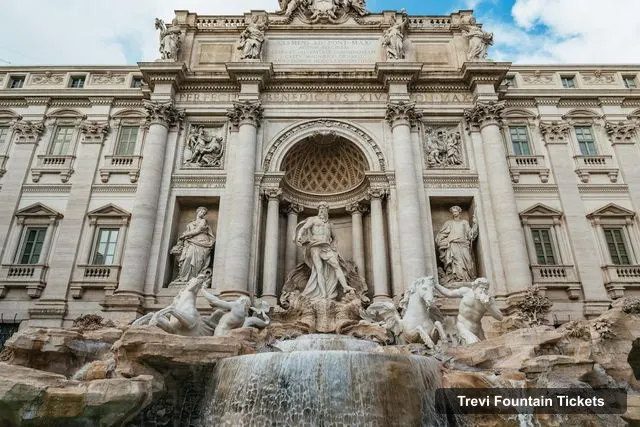
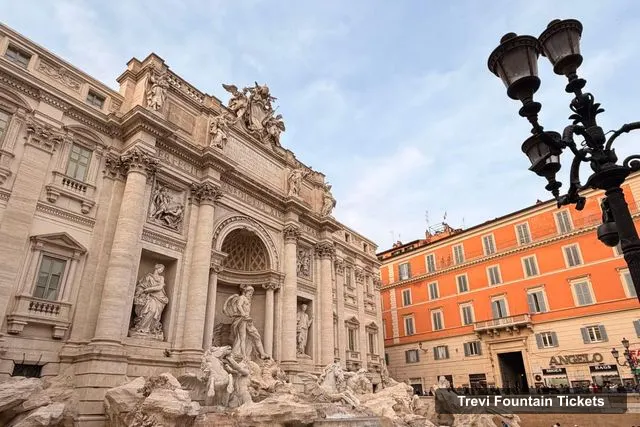
The fountain stands against the Palazzo Poli, which forms the backdrop with a giant order of Corinthian pilasters. In the central niche, Oceanus, by Pietro Bracci, rides a shell chariot. Wikipedia calls it the largest Baroque fountain in the world and gives its height as 26.3 metres (86 ft). The width appears as 49.15 metres (161.3 ft) in the introduction and 49 metres (161 ft) in the infobox, so the two differ by 15 centimetres.
Put together, the Trevi Fountain history timeline shows a long build and a short fame. The design took from 1730 to 1762, about 32 years from the competition to the inauguration, and Salvi did not live to see the result. The fountain then waited nearly two centuries for its film moments in 1954 and 1960, and in the 21st century the story has been about maintenance and managing visitors, with a restoration in 2014 to 2015, a visitor cap in 2024 and a fee in 2026. That span of 32 years is my own subtraction from Wikipedia’s dates, not a figure the article states.
Trevi Fountain History in Film and Culture
Wikipedia says Three Coins in the Fountain was released in 1954, and the fountain’s best-known scene came in 1960 when Anita Ekberg waded into the water with Marcello Mastroianni in La Dolce Vita. The Italian postal service issued a stamp showing the fountain in 1973. A LEGO set based on the fountain was released on 1 March 2025.
The coin tradition is its own story. Wikipedia cites a 2006 BBC source of about 3,000 euros thrown in daily and an estimate of 1.4 million euros (US 1.5 million dollars) for 2016. These are estimates from different years, not a measured daily figure. In 2023 climate activists dyed the water with charcoal, on 21 May.
Restorations and Crowd Control
The fountain was cleaned in 1988 to remove smog discoloration and refurbished in 1998 with recirculating pumps. In January 2013, Fendi was announced as the sponsor of a 20-month restoration costing 2.2 million euros, according to Wikipedia. It ran from June 2014 to November 2015, and the fountain reopened on 3 November 2015.
Crowds are the modern problem. In December 2024, after a three-month restoration, a queuing system opened with a cap of 400 visitors. Wikipedia says a ticketing system started on 2 February 2026 that requires non-residents to pay 2 euros. The visitor rules are the newest chapter of the Trevi Fountain history, and they are the part most likely to change again. Because rules for the basin and the square change, check the Trevi Fountain opening hours guide and the official Rome tourism site before you go.
12 Trevi Fountain Facts With Sources
Wikidata gives 1762 as the opening year (Wikidata).
Wikipedia gives the width as 49.15 metres (161.3 ft) in the introduction and 49 metres (161 ft) in the infobox (Wikipedia).
It is the largest Baroque fountain in the world (Wikipedia).
The Aqua Virgo’s source was found in 19 BC, about 13 km away, and the route grew to about 22 km (Wikipedia).
Pope Clement XII’s competition was held in 1730 and work began in 1732 (Wikipedia).
Salvi died in 1751, with the work half finished (Wikipedia).
The 2014 to 2015 restoration was sponsored by Fendi at 2.2 million euros (Wikipedia).
About 3,000 euros a day was thrown in, per a 2006 BBC source cited by Wikipedia (Wikipedia).
A ticketing system for non-residents at 2 euros started on 2 February 2026 (Wikipedia).
See the Trevi Fountain History Up Close
A guide can tell the Trevi Fountain history story in front of the basin, and the most-reviewed guided option on my list is the Trevi Fountain and Underground Guided Tour. It costs $39 for about 40 minutes, with 4.3 stars from 2,154 reviews, and the listing includes entry to the underground excavations.
Touriks
Trevi Fountain and Underground Guided Tour
★4.3 (2,154 reviews)
40 minutes
Free cancellation
My pick: The most-reviewed option: 4.3 from 2,154 reviews, about 40 minutes with a guide and the underground excavations included.
What you get, where you meet, what reviewers say
Included
✓ Guide
✓ Entrance fees into the underground excavations
✓ Headsets to hear the guide
Not included / not suitable
✕ Access to the Trevi Fountain restricted basin area (€2 fee). The guide will lead you to an excellent viewing point at the public piazza level
✕ Hotel pickup and drop-off
✕ Food and drinks
✕ Tips
Meeting point: Meet us at Piazza di Trevi 82, 00187 Rome, on the right side of the Trevi Fountain, in front of the Trevi Religious Articles shop.
Look for a member of staff holding a yellow Touriks sign. Please be at the meeting point 5 minutes before the starting time. Piazza di Trevi, 82, 00187 Roma RM, Italy
Cancellation: Cancel up to 24 hours in advance for a full refund
“Can’t remember her name but she was great, an asset to the tour and would book with her again. We could have listened to her all day!!” – GetYourGuide review
For the highest rating, the Trevi Fountain and Underground Aqueducts Tour has 4.7 stars from 370 reviews at $33, and the listing includes access to the restricted basin area.
Tix & Tours
Trevi Fountain & Underground Aqueducts Tour
★4.7 (370 reviews)
1 hour
Free cancellation
My pick: The highest-rated of the larger sellers: 4.7 from 370 reviews at $33, with the restricted basin area and the Underground City of Water.
What you get, where you meet, what reviewers say
Included
✓ Access to the restricted basin area of Trevi Fountain
✓ Entry ticket to Vicus Caprarius – the Underground City of Water
✓ Guided tour with an expert local guide
Not included / not suitable
✕ Transportation to the starting point
✕ Food and drinks
✕ Tips
Meeting point: The tour coordinator will be holding a red sign that says “Tix & Tours” in front of the church. Via di S. Vincenzo, 32, 00187 Roma RM, Italy
Languages: English
Duration: 1 hour
Cancellation: Cancel up to 24 hours in advance for a full refund
“Our guide, Eugene was the BEST!! He was very knowledgeable, patient, and easy to understand! We thoroughly enjoyed our tour &:would recommend the opportunity!” – GetYourGuide review
Work began in 1732 and Wikipedia says Giuseppe Pannini completed it in 1762, with Pope Clement XIII inaugurating it on 22 May 1762. Wikidata gives 1762 as the opening year. The designer, Nicola Salvi, died in 1751 with the work half finished.
Who designed the Trevi Fountain?+
Nicola Salvi, per Wikipedia and Wikidata. Pope Clement XII held a competition in 1730; Salvi first lost to Alessandro Galilei, then got the commission after a public outcry. Giuseppe Pannini finished it after Salvi died.
How big is the Trevi Fountain?+
Wikipedia and Wikidata give a height of 26.3 metres (86 ft). Wikipedia gives the width as 49.15 metres (161.3 ft) in the introduction and 49 metres (161 ft) in the infobox. It calls it the largest Baroque fountain in the world.
Where does the water for the Trevi Fountain come from?+
From the Aqua Virgo aqueduct. Wikipedia says Roman technicians found a source about 13 km away in 19 BC, and that the route later grew to about 22 km. The aqueduct also fed the Baths of Agrippa.
How much money is thrown into the Trevi Fountain?+
Wikipedia cites a 2006 BBC source of about 3,000 euros a day, and an estimate of 1.4 million euros (US 1.5 million dollars) thrown in during 2016. Those are estimates from different years, so do not read them as a daily rate for today.
Do you have to pay to see the Trevi Fountain?+
Wikipedia says a ticketing system started on 2 February 2026, requiring non-residents to pay 2 euros, after a queuing system with a cap of 400 visitors opened in December 2024. Rules change, so check the official Rome tourism site before you go.