The Spanish Steps are open-air and free, so there is no inside to speak of: what you need is a Spanish Steps map that shows what sits at the bottom, on the way up and at the top. This page gives you that map, the walk I would take from the metro to the terrace, and a short note on each stop. If you want more than the climb, my guide to tickets for the Spanish Steps lists the tours and classes that start here or pass by.
Spanish Steps Map: Stations and Sights Around the Steps
The map below shows the Spanish Steps with the nearest metro stations and the sights within walking distance, from Google Maps data.
Fontana dei Quattro Fiumi · Nearby sight · about 18 min walk
Piazza Navona · Nearby sight · about 18 min walk
Piazza Venezia · Nearby sight · about 18 min walk
Trajan's Column · Nearby sight · about 18 min walk
Repubblica · Station · about 19 min walk
Galleria Borghese · Nearby sight · about 19 min walk
The closest station is Spagna on Metro line A, about 70 m from the foot of the steps by Google Maps coordinates, roughly a minute on foot. Barberini is about 560 m away, around 9 minutes, and Flaminio about 860 m, around 14 minutes. Piazza Navona’s Fountain of the Four Rivers is about 1.1 km, around 18 minutes, and the Monument to Victor Emmanuel II at Piazza Venezia is about 1.3 km, around 21 minutes. These walking times are my estimates: straight-line distance multiplied by 1.3 at 4.8 km/h.
I looked for an official Spanish Steps map and found none. The Rome tourism board has a page for the steps with an interactive map and the coordinates, but no printable plan, and the staircase is a public space, not a ticketed site with a floor plan. What I give you below is my own reading order for the steps and the piazza around them, built from the tourism board, Wikipedia and the tour itineraries.
The Route I Would Walk From Spagna to the Pincio
This Spanish Steps map works best as a short walk uphill. I leave the times blank because no source times the stages, and the climb is as slow as the crowd.
My route up the Spanish Steps
1Spagna stationExit next to the piazza
2Barcaccia fountainBoat-shaped fountain from 1627 to 1629
3Foot of the stepsPiazza di Spagna
4The landings11 ramps, about 135 steps
5Trinita dei MontiThe church at the top
6Pincio terraceThe viewpoint beyond the church
Spagna Station and Piazza di Spagna
The Spagna metro stop is the easiest way in, and the Spanish Steps appear as soon as you leave it. Several guided tours meet elsewhere and reach the steps later: the Crown Tours, City Wonders and Tix and Tours walks meet near Piazza Navona, Piazza della Minerva or Piazza del Popolo, so read your confirmation. The PhotoStorica photographer waits in front of Babington’s Tea Rooms at Piazza di Spagna 23, per its listing, and the cooking classes meet inside Trattoria Amici at Via della Croce 34.
Live Virtual Guide
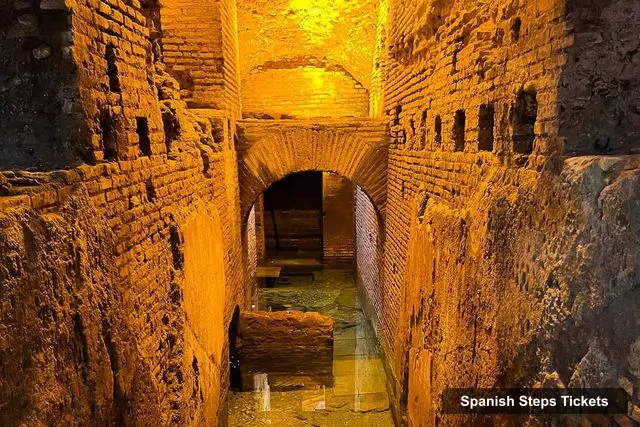
Trevi Fountain Underground Aqueduct and Spanish Steps Tour
★4.8 (581 reviews)
2 hours
Free cancellation
My pick: The tour that starts and ends in Piazza di Spagna: 2 hours, English, 4.8 from 581 reviews, $46.
What you get, where you meet, what reviewers say
Included
✓ Small group tour (max. 12 people guaranteed)
✓ Knowledgeable and friendly local guide
✓ Entry tickets to the Underground Aqueduct
✓ Direct contact via phone or WhatsApp for any questions you may have about the tour
Not included / not suitable
✕ Pickup from/to the hotel
Meeting point: Meeting point may vary depending on the option you select. Check availability for more details.
Languages: English
Duration: 2 hours
Cancellation: Cancel up to 24 hours in advance for a full refund
“Valeria was an excellent guide! She was extremely knowledgeable and easy to understand. She looked after the group at a very comfortable pace and was very helpful and engaging. I highly recommend this tour with Valeria.” – GetYourGuide review
The Barcaccia is the first thing at the base of the Spanish Steps map and sits in the piazza. Wikipedia says it was built between 1627 and 1629 and is often credited to Pietro Bernini, with Gian Lorenzo Bernini recently said to have helped with the decoration, per Wikipedia. It is a good place to look back from once you have climbed, since the piazza lies below you.
The Foot of the Steps
Francesco de Sanctis won the 1717 competition to design the stairway, per Wikipedia, and it was built between 1723 and 1725. The Rome tourism board says Pope Benedict XIII inaugurated it for the 1725 Jubilee and that it is travertine. The tourism board calls the result an extraordinary masterpiece of 18th-century scenographic taste, which is the right way to look at it from the bottom: as a stage set built to link the piazza with the church above.
The Landings: Climbing the Spanish Steps Map Step by Step
The tourism board counts 11 ramps of 12 steps each, and Wikipedia gives 135 steps on a slope about 29 m high, so I say about 135 and do not promise a figure. The balustrades break the climb into stages and serve as resting points to enjoy the view, per the tourism board. The rule to know is that sitting is not allowed: Wikipedia reports the 2019 ordinance allows a 250 euro fine for sitting and up to 400 euros for dirtying or damaging the steps, including by eating on them. Pause, take your photo and keep walking.
Trinita dei Monti
The church of Trinita dei Monti stands on Piazza Trinita dei Monti at the top, per Wikipedia. The tourism board lists it as a related place but does not describe it, so I cannot tell you its opening hours or what is inside. Check the church’s own site before you plan to go in. The top of the stairway is also the start of the Pincio, the hill that the steps ramp up.
The Pincio Terrace on the Spanish Steps Map
The Rome tourism board links the Pincio terrace and promenade from the steps page, and the PhotoStorica photoshoot lists the Pincio Terrace and Villa Borghese on its itinerary. It is the natural end of a Spanish Steps map walk, because it turns the climb into a view back over the city. I cannot give you distances beyond the top of the stairs, since my place data stops at the steps.
PhotoStorica
Spanish Steps & Hidden Gems Private Photoshoot
★5.0 (12 reviews)
30 minutes - 2 hours
Free cancellation
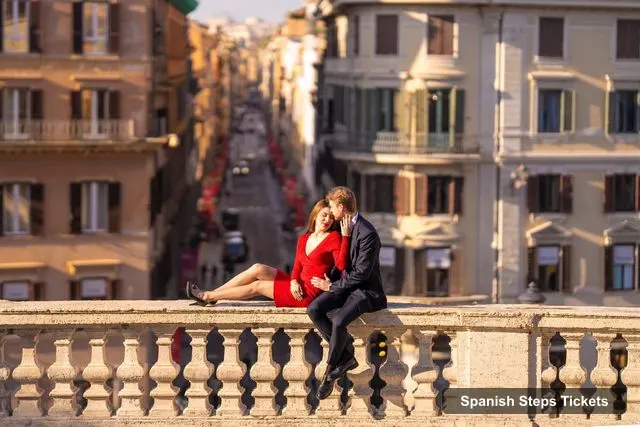
My pick: A private photographer from Babington's Tea Rooms through the steps to the Pincio Terrace: 30 minutes to 2 hours, 5.0 from 12 reviews, $61.
What you get, where you meet, what reviewers say
Included
✓ Professional photographer
✓ 20-50 professionally edited photos (depending on the selected package)
Not included / not suitable
✕ Hotel pickup and drop-off
✕ Printed and Raw photo files (for the basic package)
Meeting point: Your photographer, camera in hand, is waiting for you in front of Babington's Tea Rooms and Café (Piazza di Spagna, 23). Piazza di Spagna, 23, 00187 Roma RM, Italy
Languages: English, Italian, Persian, Spanish
Duration: 30 minutes - 2 hours
Cancellation: Cancel up to 24 hours in advance for a full refund
“The experience with jeff was incredible 😍, jeff will put you at ease directly, and will even guide you during the shoot for beautiful poses, I loved the photos, they are amazing 😍, I recommend him 1000%” – GetYourGuide review
Wikipedia says the poet John Keats lived and died in 1821 in the corner house by the piazza, now a museum, which the tourism board also lists as a place to see. The Touristation English walking tour ends at Piazza di Spagna after the Pantheon and Trevi Fountain, while the City Wonders walk runs from Piazza Navona through the Pantheon and Trevi to finish here.
Which Tours Fit the Spanish Steps Map
The tours on my list use the steps in three different ways, which is worth knowing before you book. The walking tours treat them as one stop in a day through central Rome: the City Wonders listing lists Piazza Navona, the Pantheon, Trevi Fountain and the Spanish Steps, the Crown Tours listing lists the Pantheon, Piazza Navona, Trevi Fountain and the Spanish Steps, and the Tix and Tours listing starts at Piazza del Popolo. The underground tour starts in Piazza di Spagna and goes to Trevi Fountain and the Vicus Caprarius. The cooking classes and the photoshoot are the only products that stay in this corner of the map. If you only want the steps, you do not need a ticket, and a Spanish Steps map like this one is enough to find your way.
Access and Practical Notes
The steps are outdoors and free to climb, and the tourism board’s page gives no accessibility details, referring visitors to its Rome accessible section. The surface is stone and the climb is 29 m, so check before you plan a visit with a pushchair or wheelchair. My Spanish Steps opening hours guide has the hours and the best time of day, and the story behind the staircase is on my Spanish Steps history page. When you are ready to book, compare every Spanish Steps ticket in one place. The home page lists the other attractions I cover.
Frequently asked questions
Where are the Spanish Steps on a map?+
They run between Piazza di Spagna at the bottom and Piazza Trinita dei Monti at the top, in central Rome, per Wikipedia. Google Maps gives the address as Piazza di Spagna, 00187 Rome. The Spagna metro station on line A is about 70 m from the foot of the steps.
Is there an official Spanish Steps map?+
I could not find a printable map of the steps. The Rome tourism board has a page for them with an interactive map and the coordinates, and a separate page of city maps to download, but nothing specific to the steps, so I have not linked a PDF.
How many steps are there and how do you climb them?+
Wikipedia gives 135 steps on a slope about 29 m high. The Rome tourism board describes 11 ramps of 12 steps each, with balustrades that serve as resting points. The two counts differ by a few steps, so I say about 135.
What is at the top of the Spanish Steps?+
The church of Trinita dei Monti stands at the top, on Piazza Trinita dei Monti, per Wikipedia. From there the Rome tourism board links the Pincio terrace and promenade, which is reached from the top of the stairway.
Can you sit on the Spanish Steps?+
Rome's 2019 regulation bans sitting on monuments including the steps, and Wikipedia reports a 250 euro fine for it. You can walk up and down and pause on the landings, but I would not eat or sit.