Circus Maximus facts are easy to find and hard to trust, because the ancient numbers are huge and the modern ones disagree with them. This page puts the history on a dated timeline, walks through it period by period, and ends with a numbered list of Circus Maximus facts with the source for each. Almost everything comes from Wikipedia, and where that article gives two figures for the same thing, I give both. Wikidata had no usable match for this site, so I did not use it. If you want to stand on the track after reading, my page on tickets for the Circus Maximus shows what is free and what is not.
Circus Maximus History Timeline
Year
What happened
494 BC
Manius Valerius Maximus and his descendants get a curule chair at the southeastern turn
366 BC
The Ludi Romani are held at the Circus, the earliest attested Roman Games there
329 BC
Permanent wooden starting stalls are built
174 BC
At least from this year, laps are counted with large sculpted eggs
About 50 BC
Julius Caesar’s development extends seating almost the full circuit
33 BC
Bronze dolphin-shaped lap counters are added
31 BC
A fire damages the wooden bleachers
36 AD
A fire starts in a basket-maker’s workshop under the stands
64 AD
The Great Fire of Rome damages the Circus; it is rebuilt to the same footprint
81 AD
The Senate builds a triple arch honouring Titus at the curved end
103 AD
A coin of Trajan commemorates the restoration of the Circus
523 AD
The last known beast-hunt
549 AD
The last known races, held by Totila
1587
Pope Sixtus V removes two obelisks from the central barrier
1852
A gasworks is built on the site; it moves out in 1910
Circus Maximus History and Facts: Legend and Early Games
The oldest Circus Maximus history is legend. Wikipedia says Romulus is said to have found the shrine of Consus and founded the Consualia, a festival with horse races, and that Livy credits Lucius Tarquinius Priscus with the first raised wooden seating. The first historically attested games are the Ludi Romani of 366 BC, held in honour of Jupiter.
The setting is the valley between the Palatine and Aventine hills in Rome, and over the centuries the site gained permanent wooden starting stalls in 329 BC and stone track-side seating for senators in the 190s BC. In 169 BC a hunt used 63 leopards and 40 bears and elephants, per the same source. The games grew until they filled 57 days a year in the late Republic and 135 days in the Empire.
Circus Maximus Facts About the Track and Races
A race typically ran seven laps, and the starting stalls were reduced to twelve by the late Republic or early Empire. Laps were counted with large sculpted eggs from at least 174 BC, and bronze dolphin-shaped counters were added in 33 BC. A curule chair at the southeastern turn had been granted to Manius Valerius Maximus and his descendants in 494 BC.
Augustus had an obelisk brought from Heliopolis and built the pulvinar, the imperial box, though Wikipedia does not date either. In 1587 Pope Sixtus V removed two obelisks from the central barrier, and one of them was re-sited at the Piazza del Popolo. Which obelisks stood where is a subject for another page; what matters here is that the barrier was once crowded with monuments.
Circus Maximus Facts on Size and Capacity
Wikipedia gives a length of 621 m (2,037 ft). The width is where the article disagrees with itself: the introduction says 118 m (387 ft), while the section on Julius Caesar’s development says 150 m (490 ft). I would treat the width as roughly 118 to 150 m until a source reconciles them.
Capacity is even less certain. A modern recalculation gives over 150,000 spectators. Pliny the Elder estimated 250,000, which Wikipedia calls unlikely, and some late regionary catalogues give an impossible 450,000. A seating collapse in the reign of Diocletian killed some 13,000 people, per the same article. These numbers are why the best Circus Maximus facts are the ones that come with the phrase “according to”.
Circus Maximus History: Fires, Stone and Decline
The wooden Circus burned more than once. Wikipedia lists a fire in 31 BC that damaged the bleachers, one in 36 AD that began in a basket-maker’s workshop under the stands, and the Great Fire of Rome in 64 AD, after which it was rebuilt to the same footprint and design. Under Trajan it was rebuilt entirely in stone, and Pliny claims his works added 5,000 seats. In 81 AD the Senate built a triple arch honouring Titus at the curved end.
By the late first century AD the Colosseum and the Stadium of Domitian were in use, and the Circus had become Rome’s main chariot-racing venue. The end came slowly: the last known beast-hunt was in 523 AD and the last known races, held by Totila, in 549 AD.
Circus Maximus Facts From Ruin to Park
After the races stopped the site was reused. Wikipedia says the Circus was replaced by rented dwellings in the 11th century, a watercourse was dug to drain the soil in the 12th, and in the 16th century the area became a market garden. The Anglo-Italian Gas Society built a gasworks there in 1852, which moved to the edge of Rome in 1910. In the mid-19th century workings uncovered the lower parts of a seating tier and an outer portico.
The original track is now about six metres below the modern surface, which is why a visit to the open grass shows a shallow valley and little else. Italian World Cup victory celebrations were held at the site in 2006. For what is open, see my Circus Maximus opening hours guide and the Rome tourism page for the Circus Maximus.
13 Circus Maximus Facts With Sources
The Ludi Romani of 366 BC are the earliest attested Roman Games at the Circus (Wikipedia).
Permanent wooden starting stalls were built in 329 BC (Wikipedia).
The starting stalls were reduced to twelve by the late Republic or early Empire (Wikipedia).
Games filled 57 days a year in the late Republic and 135 days in the Empire (Wikipedia).
A seating collapse under Diocletian killed some 13,000 people (Wikipedia).
The last known beast-hunt was in 523 AD and the last known races in 549 AD (Wikipedia).
Pope Sixtus V removed two obelisks from the central barrier in 1587 (Wikipedia).
The original track is now about six metres below the modern surface (Wikipedia).
See the Circus Maximus Facts on the Ground
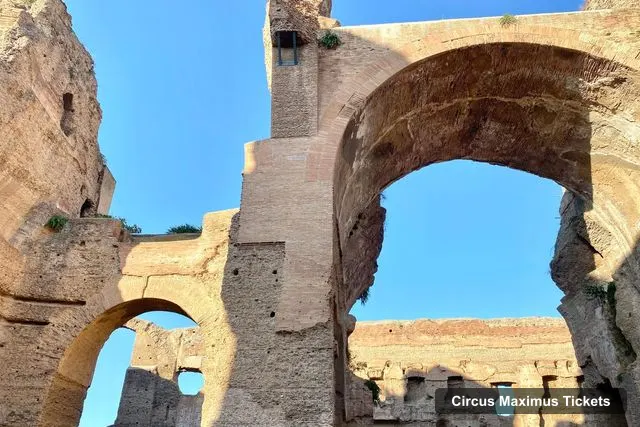
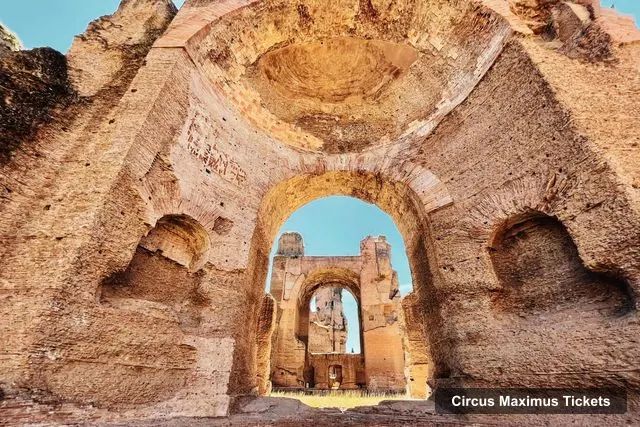
With so little standing, a guide is what turns these Circus Maximus facts into something you can picture. My pick is the Caracalla Baths and Circus Maximus tour, private or shared: $72, rated 4.7 from 991 reviews, about 1.5 hours with a live archaeologist guide, headsets and entry to the Baths of Caracalla.
Touriks
Caracalla Baths & Circus Maximus — Private or Shared
★4.7 (991 reviews)
1.5 hours
Free cancellation
My pick: The most-reviewed option: $72, 4.7 from 991 reviews, 1.5 hours, Baths of Caracalla entry included.
What you get, where you meet, what reviewers say
Included
✓ Entrance fees to the Caracalla Baths
✓ Sterilized headsets to hear clearly your guide
✓ Live archeologist guide
✓ Full on-site assistance
Not included / not suitable
✕ Hotel pick-up and drop-off
✕ Food and drinks
✕ Optional tips
Meeting point: Meet your guide at the exit of the Metro Station "Circo Massimo" (in the direction of "Laurentina") in front of the FAO building. Look for a yellow label with the local partner's name written on it. Viale Aventino, 3, 00153 Roma RM, Italy
Languages: English, Spanish, French, German, Portuguese, Italian
Duration: 1.5 hours
Cancellation: Cancel up to 24 hours in advance for a full refund
“Good tour. The Caracalla baths came to life through our tour guide. Thoroughly. Delighted.” – GetYourGuide review
For a small-group guided walk, the Caracalla Baths and Circus Maximus guided tour is $84, rated 5 from a single review, so treat that rating as an early signal only.
ROME WITH SILVIA
Caracalla Baths and Circus Maximus Guided Tour
★5.0 (1 reviews)
1.5 hours
Free cancellation
My pick: A small-group guided tour: $84, 5 from 1 review, 1.5 hours with headsets.
What you get, where you meet
Included
✓ Small group size
✓ English-speaking guide
✓ Headsets to hear your guide clearly
✓ Guided tour of the Caracalla Thermal Complex and Circus Maximus area
✓ Access to the ruins
✓ Expert insights and stories about the history and architecture
Not included / not suitable
✕ Tips
Meeting point: The guide and the staff assisting the group will meet the clients outside the metro station "Circo Massimo" with the company flag. Viale delle Terme di Caracalla, 00153 Roma RM, Italia
Languages: English
Duration: 1.5 hours
Cancellation: Cancel up to 3 days in advance for a full refund
Wikipedia gives a length of 621 m (2,037 ft). It gives the width as 118 m (387 ft) in the introduction but 150 m (490 ft) in the section on Julius Caesar's development, and does not reconcile the two figures.
How many people could the Circus Maximus hold?+
Wikipedia says a modern recalculation gives over 150,000 spectators. Pliny the Elder estimated 250,000, which the article calls unlikely, and some late regionary catalogues give an impossible 450,000.
When was the last race at the Circus Maximus?+
Wikipedia gives 549 AD as the last known races, held by Totila. The last known beast-hunt was in 523 AD.
Why is the Circus Maximus empty today?+
Because the stone seating was robbed and buried. Wikipedia says the Circus was replaced by rented dwellings in the 11th century, drained in the 12th and used as a market garden in the 16th. The original track is now about six metres below the modern surface.
Are there tickets for the Circus Maximus?+
Walking across the grass is free. The fenced archaeological area with the Circo Maximo Experience is a paid visit, and guided tours that combine it with the Baths of Caracalla are on my page about tickets for the Circus Maximus.